Construction businesses in South Africa are expected to maintain reliable site-access and working-time records. That need comes from a combination of health and safety duties under the Occupational Health and Safety Act framework and employee time-record obligations under the BCEA. Yet on sites across the country, the practical site register is still a damp A4 pad clipped to a fence post, filled with illegible names and no timestamps. That is the gap this article addresses.
What the Law Actually Requires
The Construction Regulations 2014, promulgated under the OHS Act 85 of 1993, place specific obligations on both principal contractors and contractors operating on construction sites. Those duties include maintaining a health and safety file, contractor lists, induction records, and the supporting documentation needed to show who is authorised to work on the project.
The Construction Regulations require a principal contractor to keep a health and safety file for each project. That file must include the contractor and subcontractor information, health and safety plans, and related project records required by the regulations. Many contractors pair those OHS records with a practical site register so they can show who was on site on a given day and connect that back to inductions, supervisors, and incidents if something goes wrong.
This is not only a health and safety matter. The Basic Conditions of Employment Act (BCEA) separately requires every employer to keep a written record of each employee's ordinary hours of work, overtime worked, and pay received. These records must be kept for three years and must be available for inspection by a Department of Labour inspector at any time.
A site register, done properly, satisfies both sets of requirements at once. It records who is on site, when they arrived, when they left, and therefore how many hours they worked. That daily record becomes the foundation of your payroll, your compliance audit trail, and your protection in any CCMA dispute.
The record-keeping burden applies regardless of site size. A crew of six on a residential renovation still needs defensible employee hour records and supporting site documentation, even though the paperwork looks different from a 200-person civils project. The scale differs; the compliance burden does not.
What the Site Register Must Actually Contain
A compliant site register is not just a list of names. It needs to capture enough information to prove, if required, that your site was managed safely and that your workers were paid correctly.
At minimum, a construction site register in South Africa should record:
- The full name and ID number of every worker who enters the site
- The name of their employer, especially when subcontractors are involved
- Their time of arrival and time of departure each day
- The date of each entry
- A signature or verified acknowledgement of entry
A well-run site will also note visitor arrivals separately, record the credentials of contractor supervisors, and link the register to the broader health and safety file. On unionised sites or where a collective agreement applies, the register may also need to capture the agreement applicable to each worker.
That last point matters more than most managers realise. South Africa's labour law is specific about who counts as an employee, what protections apply, and when overtime kicks in. A site register that records only names, with no timestamps, cannot demonstrate BCEA compliance. If a worker claims they were on site for ten hours and your register shows nothing, your dispute starts from a weak position.
Why Paper Registers Are a Liability
A paper register feels simple. One sheet, a pen, done. But it creates several problems that compound over a project's lifespan.
Entries are unverified. Anyone can write any name in a paper register. A foreman signing in a worker who arrived an hour late, or a worker signing in on behalf of someone who never showed up, leaves no trace. Buddy punching is a known problem on South African construction sites, and a paper register does nothing to prevent it. It records what people write, not what actually happened.
Timestamps are unreliable. Without a system recording the exact time of each entry, you are relying on workers and supervisors to manually note their arrival time honestly. In practice, entries are often written in bulk at the end of the morning, at lunch, or at the end of shift. The result is a register full of rounded times that bears no reliable relationship to when people actually arrived or left.
Records get lost or damaged. Sites are outdoor, often wet, and frequently chaotic. Paper registers go missing. Pages tear. Ink runs. A three-year record-keeping obligation is difficult to meet if the records disappear after three weeks.
You cannot see across sites. If you run multiple sites, a paper register on each one gives you no consolidated view. You cannot, at a glance, tell your payroll team how many hours each worker logged across the week. Instead, someone has to collect sheets, transcribe entries, and reconcile them against a spreadsheet, a process that takes time and introduces errors.
These are not small problems. Payroll errors that flow from inaccurate attendance records cost money. Inaccurate overtime calculations create BCEA liability. A missing register during a Department of Labour inspection creates a compliance failure. The time tracking mistakes construction managers make most often trace back to a weak attendance record at the start of the chain.
What a Digital Site Register Does Differently
A digital site register replaces the pen-and-paper process with a system that records entries automatically, timestamps them accurately, and stores them where they cannot be lost.
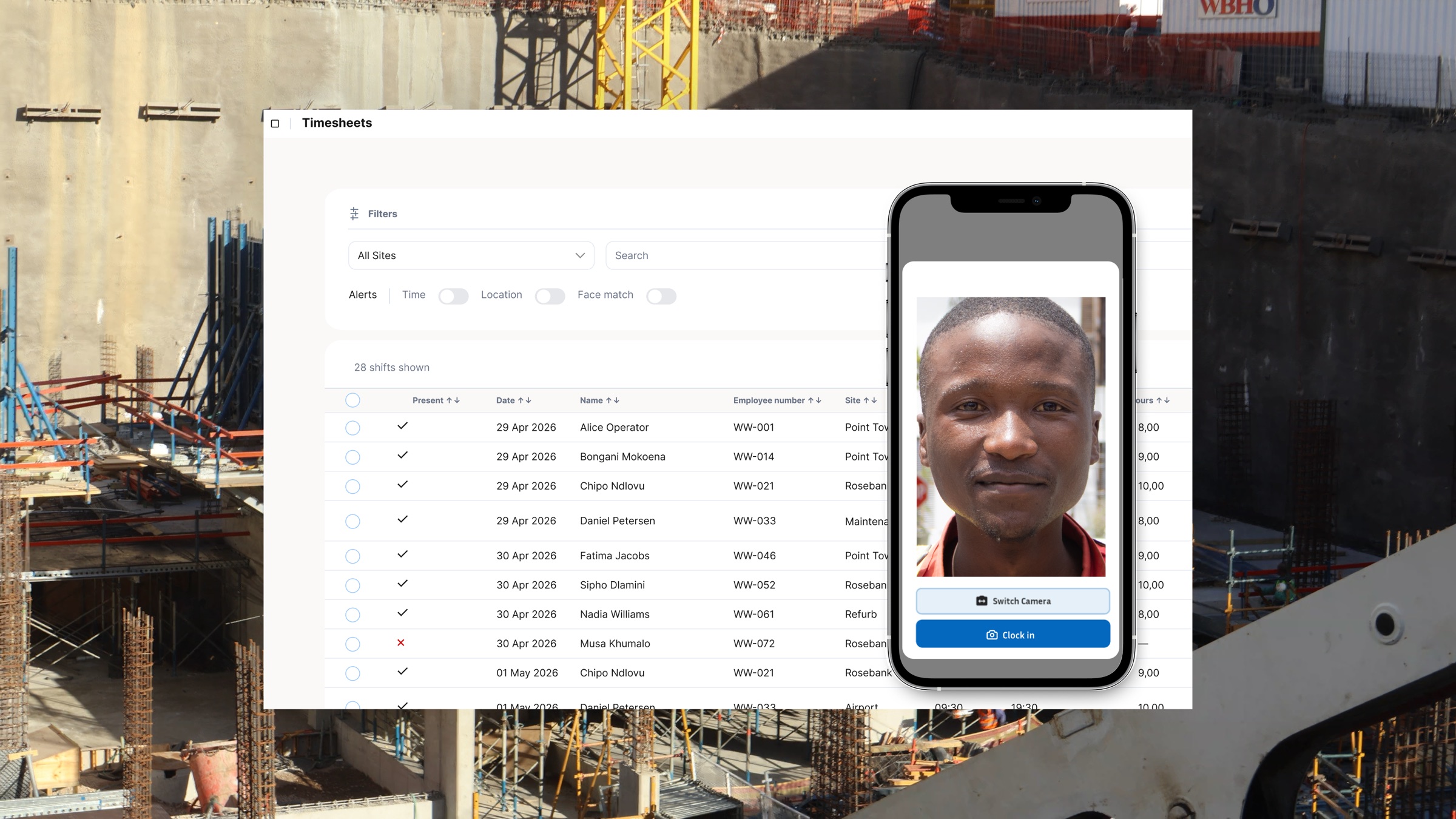
WorkWeek's approach is built specifically for South African construction sites. Workers clock in using facial recognition on a tablet or smartphone at the site gate. The system matches their face against a stored profile, so the person clocking in is confirmed as the person in the record. That confirmation is timestamped to the second and stored with the worker's name, site, and shift date.
This solves the verification problem that paper cannot. When a worker clocks in on WorkWeek, you know who it was, when it happened, and which site they were on. No foreman approval required, no manual transcription needed.
For multi-site operations, the system gives managers a consolidated view across every site in real time. If you have crews working in Midrand, Durban, and Cape Town simultaneously, you can see attendance across all three without waiting for anyone to compile reports. That visibility is particularly useful for weekly payroll runs and for managing subcontractor attendance where you are billing on an hours basis.
The system also works in low-connectivity environments, which matters in construction. WorkWeek is built for data-free operation, recording entries locally and syncing when connectivity returns. A remote civil engineering site without stable data does not need to stop clocking workers in.
Where employee documentation for construction is concerned, the digital site register creates a persistent, searchable audit trail. At the end of a project, you have a complete record of every person who worked on site, every day they were present, and every hour they logged. That record can be exported for compliance purposes, used to respond to a Department of Labour inspection, or submitted as evidence in a CCMA dispute.
The Register Is the Start of Your Payroll
The connection between a site register and accurate payroll is direct. The register records who was there and for how long. That data determines ordinary hours, overtime hours, and leave taken. If the register is unreliable, everything downstream is unreliable.
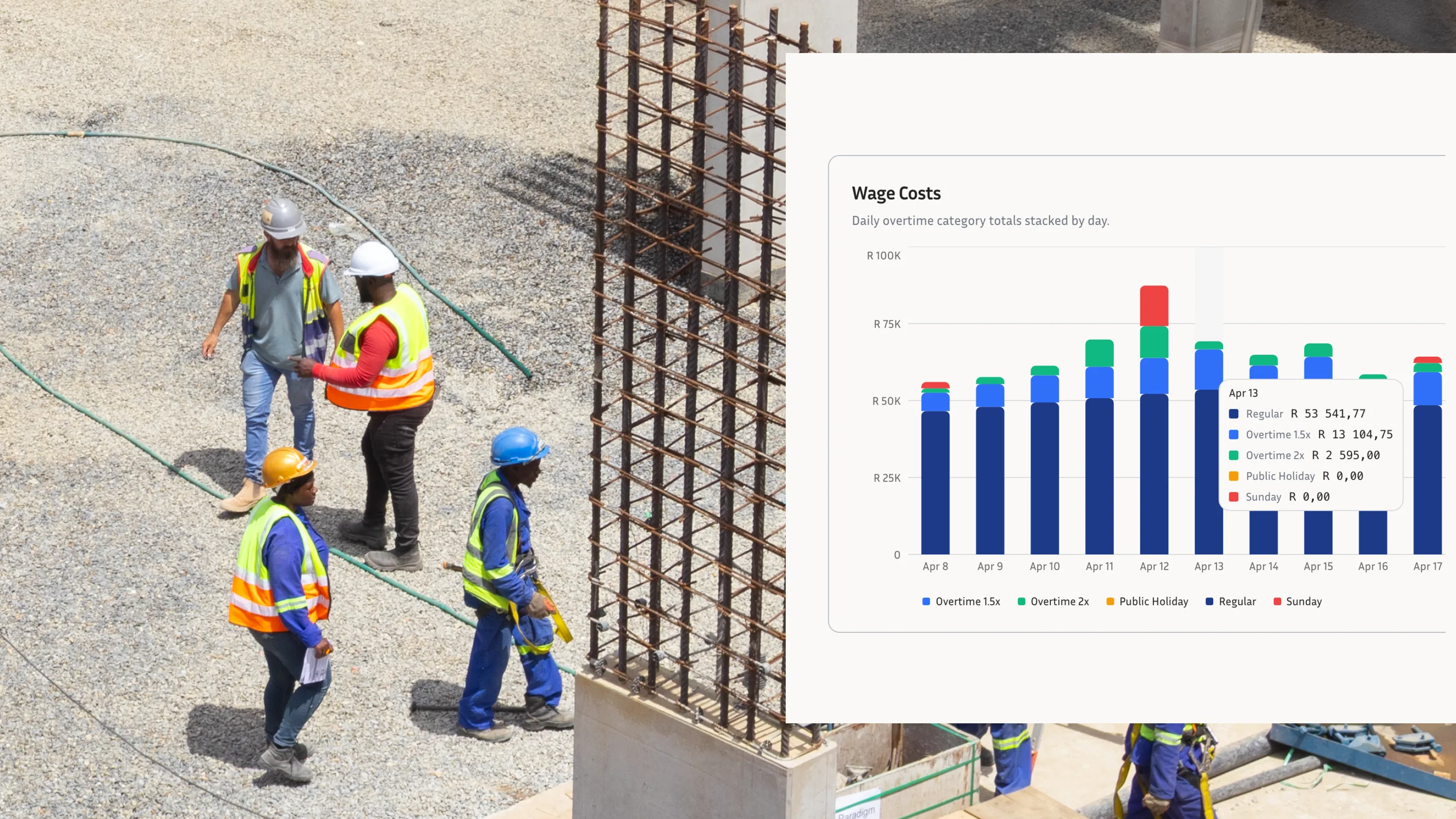
South Africa's BCEA sets out specific rules on overtime: 45 ordinary hours per week, overtime at 1.5 times the ordinary rate, and Sunday pay at 2 times the ordinary rate for non-agreed Sundays. Calculating these correctly requires accurate hour-by-hour data, starting with a reliable record of when each worker arrived and left each day.
A clocking system for employees that creates payroll-ready records removes the manual transcription step where most errors occur. Hours recorded at the gate are available for payroll review with overtime thresholds already calculated. The result is a payroll run based on what actually happened on site, not what someone transcribed from a damp sheet of A4.
For businesses running accurate time tracking across South African sites, this is where the site register becomes a business tool, not just a legal checkbox. The same data that satisfies your OHS compliance obligation also drives your payroll, informs your project costing, and tells you whether your crew sizes are matching your output targets.
Make the Register Work For You
The site register is a legal requirement you are already obligated to keep. The question is whether you keep it in a way that exposes you to risk, or in a way that protects your business and simplifies your operations.
Paper registers tick a box on a good day. On a bad day, they leave you exposed to Department of Labour inspectors who find missing records, to CCMA hearings where you cannot prove hours, and to payroll runs that cost more than they should because the input data was never reliable.
A digital site register changes the equation. It records attendance automatically, verifies worker identity, stores records securely, and produces payroll-ready attendance data without manual transcription. WorkWeek is built to do exactly this, for South African construction sites, with no data costs for workers and no hardware dependency.
If you want to see how it works on a site like yours, get in touch with the WorkWeek team. The register you are legally required to keep can do a lot more than prove you ticked a box.