Construction sites run on hours. Get those hours wrong and your overtime bill balloons, workers lose trust, and you hand the CCMA a ready-made case against you. This guide walks through the exact BCEA overtime calculation, the rates you need to pay, and what it takes to get that right every single pay cycle.
What the BCEA Actually Says About Overtime
The Basic Conditions of Employment Act sets the baseline for every worker earning below the current earnings threshold, which sits at R269,600.90 per year as of 1 May 2026. Workers earning above that figure can agree in writing to different arrangements, but for most construction labourers, foremen, and tradespeople, the BCEA rules apply in full. If you are not certain which of your workers fall above or below that line, read the full breakdown of the 2026 BCEA earnings threshold before you run your next payroll.
Ordinary working hours cap at 45 hours per week: nine hours a day over five days, or eight hours a day over six days. Anything beyond that is overtime. The default BCEA limit is 10 hours of overtime per week, although a qualifying collective agreement can temporarily increase that to 15 hours per week for up to two months in a 12-month period. No single shift should exceed 12 hours total. Those limits matter in construction, where early starts, extended concrete pours, and tight programme deadlines push crews well beyond the standard shift on a regular basis.
How to Calculate the Overtime Rate in South Africa
The BCEA overtime rate for weekday overtime is 1.5 times the worker's normal hourly rate. Sunday overtime, when Sunday is not the worker's ordinary working day, is calculated at 2 times the normal rate. Public holiday pay depends on whether the day was an ordinary working day: ordinary public holidays generally attract at least double the ordinary amount for the day, while non-ordinary public holidays require the ordinary daily wage plus the amount earned for the work performed. The BCEA Sunday and public holiday rate guide covers the additional nuances for six-day rosters.
To apply those multipliers correctly, you first need the verified hourly rate. The calculation runs as follows.
Step 1: Establish the hourly rate
Divide the worker's monthly salary by the number of ordinary working hours in that month. The standard figure for a full-time worker on a 45-hour week is 195 hours per month, which is 45 hours multiplied by 4.33 weeks.
Example: A labourer earns R8,775 per month and works a standard 195-hour month.
R8,775 divided by 195 equals R45.00 per hour.
Step 2: Apply the correct BCEA multiplier
- Weekday overtime: R45.00 x 1.5 = R67.50 per hour
- Sunday, when Sunday is not an ordinary working day: R45.00 x 2 = R90.00 per hour
- Public holiday on an ordinary working day: at least double the ordinary amount for that day, or the ordinary day's pay plus the amount earned for the time worked, whichever is greater
If the public holiday falls on a day the employee would not ordinarily work but the employee does work, the employer must still pay the ordinary daily wage plus the amount earned for the work performed. That is why a partial public-holiday shift cannot safely be reduced to a flat hourly x2 example.
Step 3: Multiply by verified overtime hours worked
If that labourer worked 8 hours of weekday overtime in a given week, R67.50 x 8 = R540.00 in overtime pay for that week.
Most businesses get the multipliers right. Where they go wrong is the input: the actual number of verified overtime hours.
Where Overtime Calculations Break Down on Site
Accurate overtime calculation depends entirely on accurate time data. If your hours come from paper timesheets, supervisor sign-off, or workers recording blocks rather than actual start and finish times, your overtime figure is a best guess, not a calculation.
Three patterns consistently produce wrong overtime figures on South African construction sites.
The first is fixed-shift assumptions. A supervisor records everyone as working 07:00 to 16:00, regardless of what actually happened. Workers who stayed until 18:30 to finish a pour get paid for nine hours. The extra two-and-a-half hours disappear from the record, and that is an underpayment that is legally actionable under the BCEA.
The second is ghost hours. A worker clocks in and out for a colleague who arrived late or left early. The overtime line in payroll is fabricated, and the business pays for hours that were never worked. Across a crew of 40, even occasional ghost clocking adds up fast.
The third is threshold miscounting. For employees who work five days or fewer in a week, ordinary time is capped at 45 hours in the week and nine hours in any day. For employees who work more than five days in a week, the daily ordinary-hours cap is eight hours. Some payroll processes only watch the weekly total and miss daily overtime entirely, while others pay overtime from hour nine on day one without checking whether that worker's schedule or weekly total actually triggered it. The error per worker is small, but across a full workforce and a full year the exposure is significant.
Accurate time tracking is not about watching workers. It is about having a clean, verified record that protects both the business and the worker if a dispute lands at the CCMA.
Why Manual Overtime Tracking Does Not Scale
A site manager running a single 12-person crew can track hours on a spreadsheet. Run three crews across two or three sites, add casual workers on different weekly schedules, and factor in a few Sunday shifts and a public holiday, and the manual process falls apart quickly.
Overtime calculations require per-worker data: ordinary hours for the week, shift pattern, day of the week the extra hours fell on, the public holiday calendar, and the applicable rate. A single data entry error on the wrong day can mean the difference between paying 1.5 times and paying 2 times on a full shift. The CCMA does not accept "I made a mistake on the spreadsheet" as a defence, and underpaying overtime is a BCEA violation regardless of intent. Payroll accuracy is not just a compliance concern. It is a competitive edge for construction contractors who need clean, auditable records when tendering for new work.
How a Clocking System Handles Overtime Automatically
A clocking system that records actual start and end times, verified against worker identity, gives you the accurate input your overtime calculation depends on.
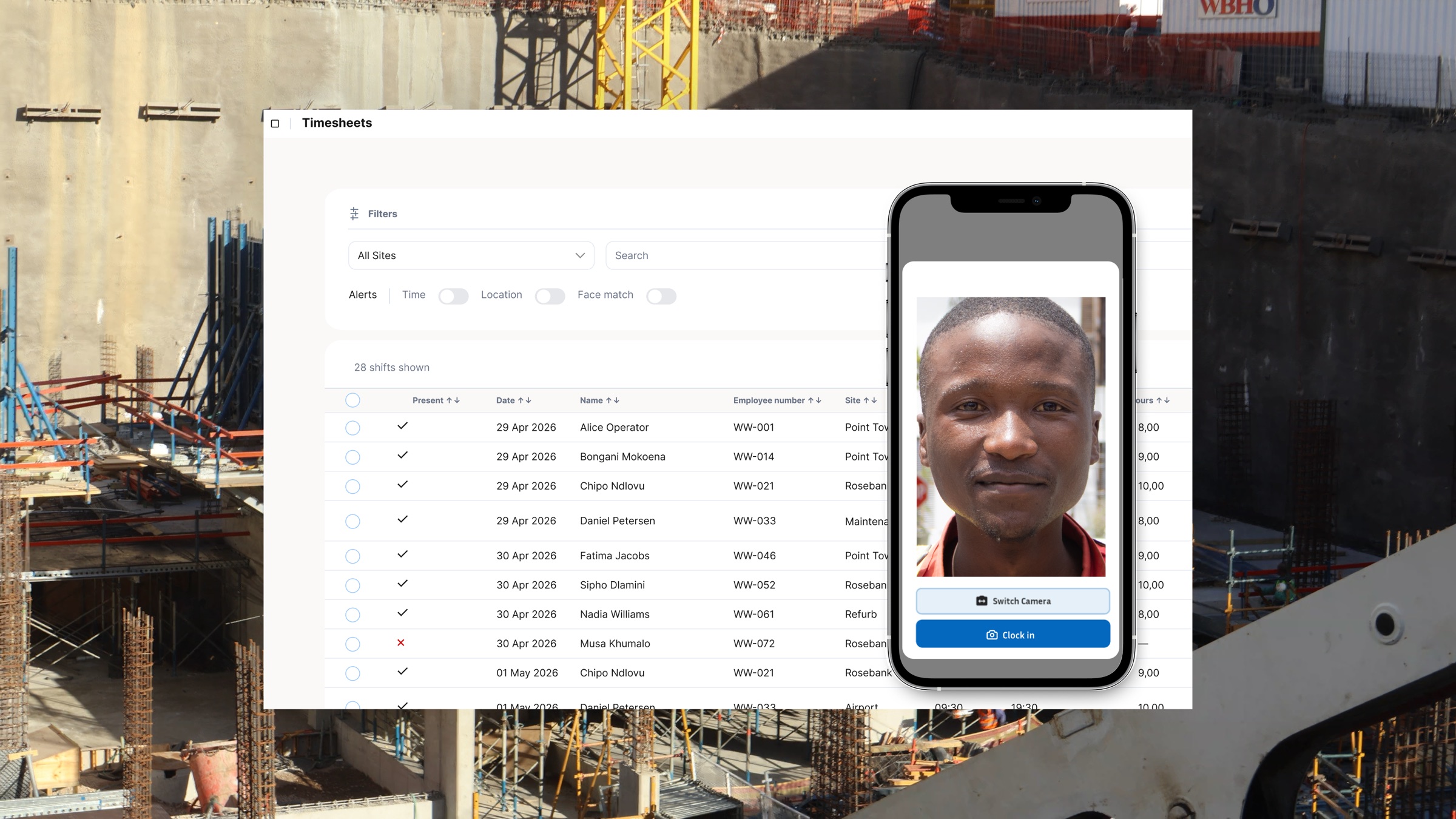
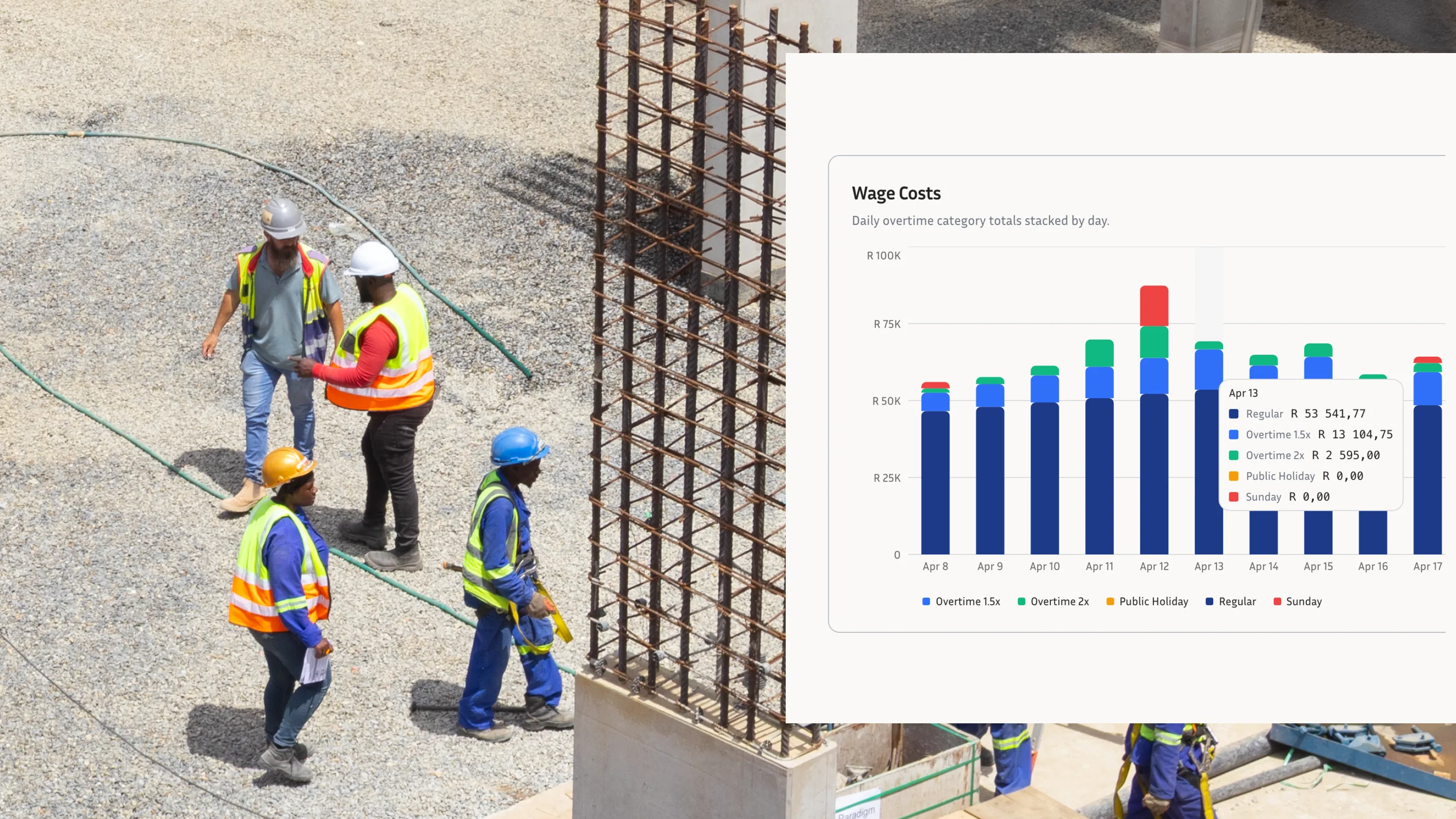
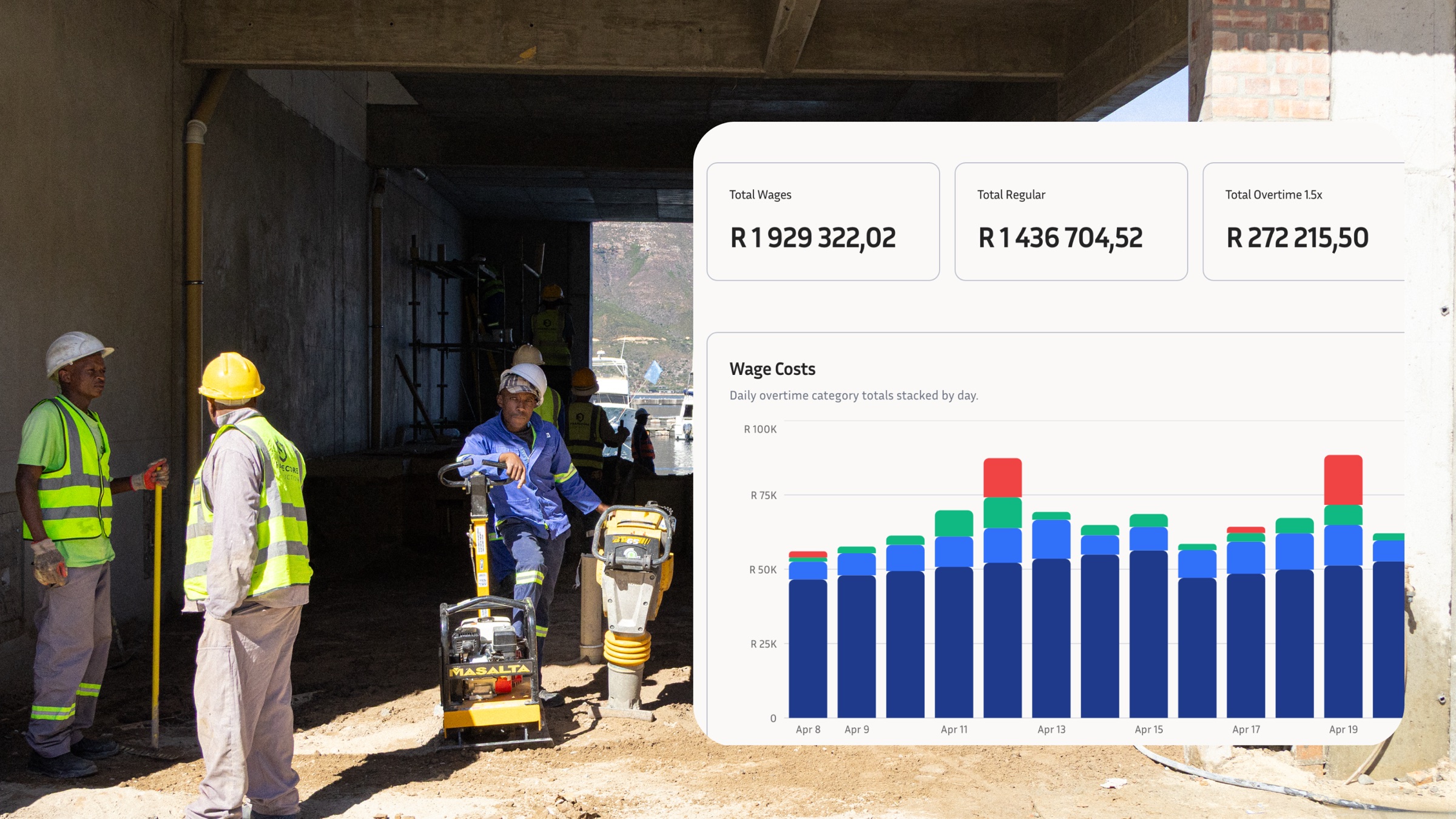
WorkWeek's smart time recording captures verified clock-in and clock-out times using facial recognition on a tablet or smartphone at the site gate. No punch cards. No paper. No proxy clocking. In the payroll export, overtime can be identified against both the weekly threshold and the applicable daily ordinary-hours cap for the worker's schedule. Sunday shifts can then be classified against the worker's roster so payroll applies 1.5x for ordinary Sundays and 2x where Sunday is not an ordinary working day, without a supervisor needing to manually override a default figure.
The employee authentication built into that process removes ghost hours entirely. Every clock-in is tied to a confirmed identity. No face, no clock-in. For multi-site operations, managers get consolidated visibility across all locations, so you can see when a crew is approaching the threshold before Friday afternoon, not after.
Businesses still relying on manual hours are not just risking payroll errors. They are building CCMA exposure into every pay cycle. The fix is verified time data that produces payroll-ready records with BCEA rules applied before payroll review. If you are ready to move to that, see how WorkWeek works or speak to the team directly.