Paper timesheets go missing on dusty sites. Fingerprint scanners jam up in wet conditions or leave forty workers queuing at the start of a shift. By the time payroll closes at month end, someone is disputing hours that nobody can verify. This is the daily reality for construction companies across South Africa still running fixed or paper-based clock in systems. More operations managers are replacing that model with a mobile-based clocking system for employees. The reasons are practical, not trendy.
Fixed Hardware Clocking Has Limits That Construction Sites Cannot Afford
Biometric clocking hardware made sense when most businesses operated from a single building with controlled entry points. A construction site is a different environment entirely. Workers move between zones, sub-contractors come and go, and your headcount on a Wednesday afternoon may look nothing like it did on Monday morning.
A biometric clocking system bolted to a wall at the site office only captures the workers who pass through that one point. Workers on the far end of a large site, on scaffolding, or dispatched to a secondary location don't always clock through. Supervisors end up filling in timesheets manually. That's where errors start, and that's where disputes follow.
Fixed hardware also breaks. Dust, concrete powder, moisture, and sun exposure all take a toll on biometric clocking devices. A malfunctioning scanner during a shift handover is not a minor inconvenience. It creates gaps in your attendance records, which causes problems when you calculate overtime or need to verify hours for a CCMA dispute.
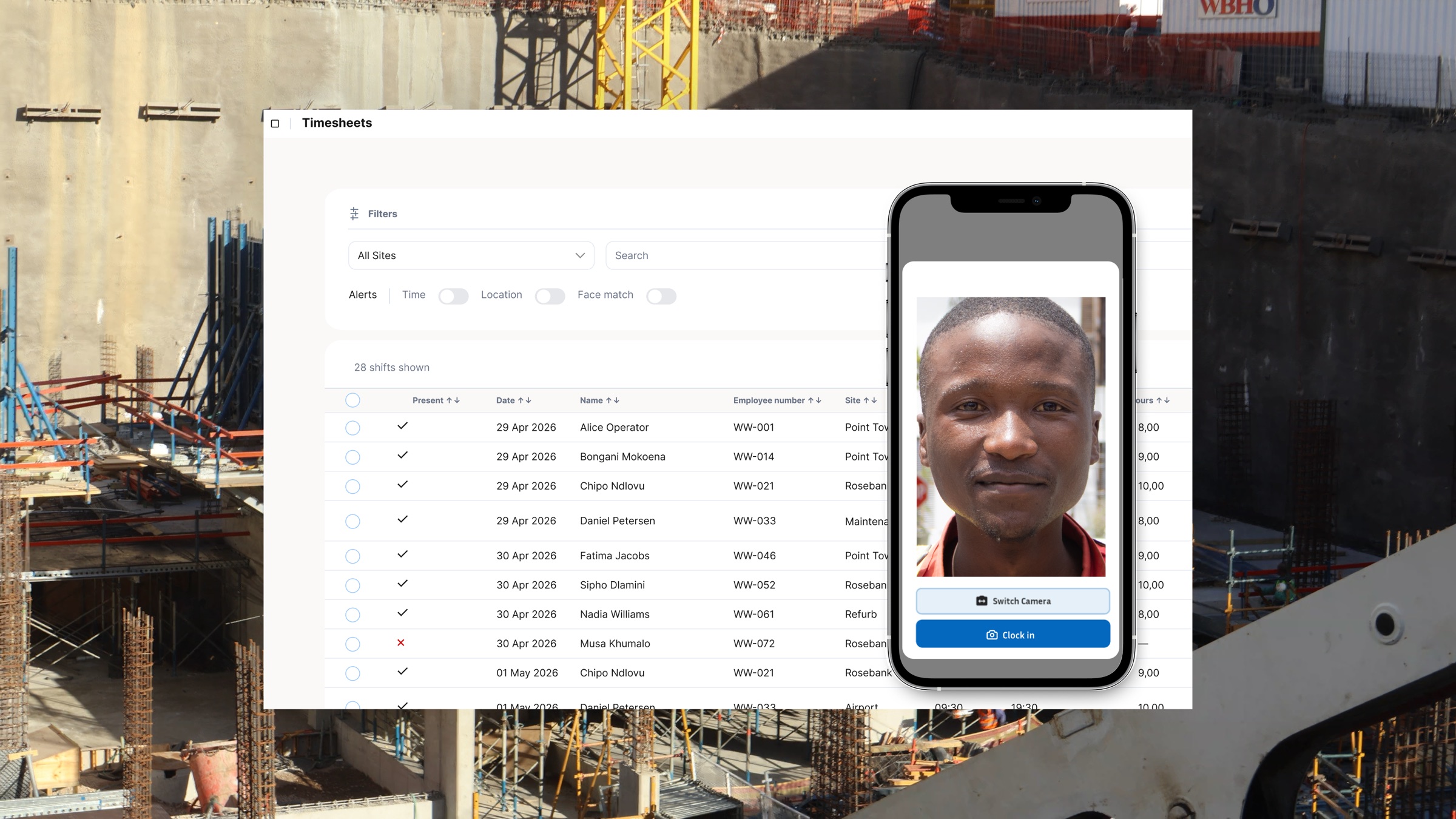
Mobile-based systems change this by using the devices workers and supervisors already carry. A smartphone becomes the clocking station. GPS confirms location. Facial clocking confirms identity. No queue. No hardware failure. No blank timesheet at month end.
How a Mobile Clocking System Works on a Real Construction Site
A mobile clocking system for employees does not require every worker to own a smartphone. Most systems allow a supervisor or site manager to handle clocking on behalf of a team using a single device. Workers can be clocked in and out in bulk, with each individual's identity confirmed through facial clocking or a unique PIN. The record is timestamped, geotagged, and stored automatically.
This matters for multi-site operations. If you're running three road construction projects across two provinces, your central office needs visibility across all of them without calling every site manager for a daily headcount. Good workforce management software gives you that view from one dashboard: who is on site, which shifts have started, and which sites are running short.
The timesheet app replaces the paper register. Hours are ready for payroll calculations at the end of each period, with none of the manual transcription errors that inflate payroll costs or short-change workers. Good HR software for South African businesses gives you this compliance trail automatically, because every clock-in carries a verifiable record.
For operations working across areas with limited data coverage, some systems offer data-free time tracking, which means clocking still works even when a site doesn't have a reliable signal. WorkWeek's data-free time tracking is built specifically for this kind of environment, where connectivity is inconsistent but accuracy still matters.
Labour Law Compliance Depends on Getting Time Right
The Basic Conditions of Employment Act sets clear rules about working hours, overtime, and leave entitlements. Getting this wrong costs money. In the case of a CCMA dispute, it can cost significantly more.
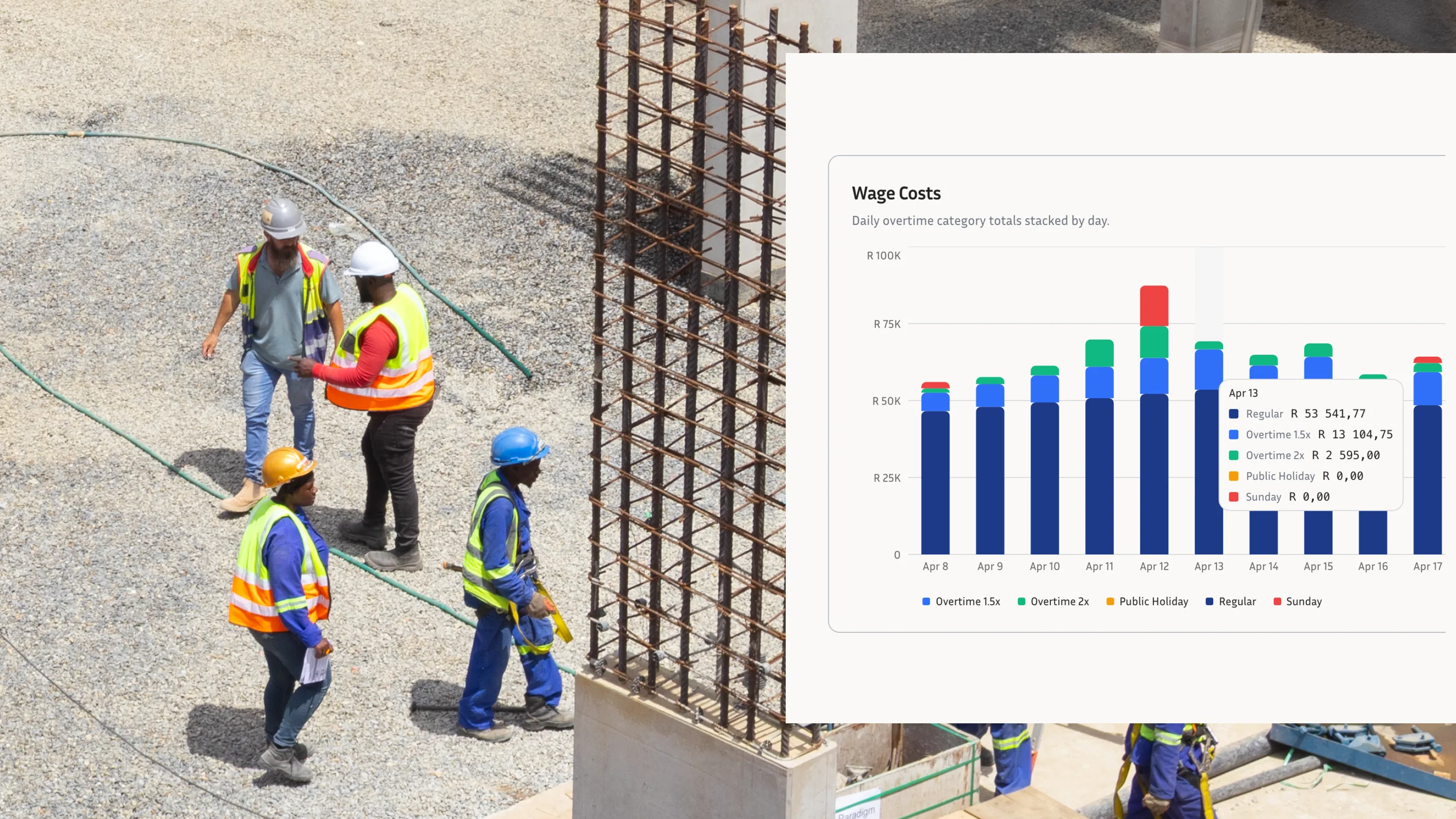
Under the BCEA, the standard working week is 45 hours. Anything beyond that triggers overtime provisions. The overtime rate South Africa employers must pay is 1.5 times the worker's ordinary wage for hours worked beyond that threshold, and double time applies on Sundays and public holidays. These numbers are fixed by labour law South Africa-wide, not by company policy.
Manual timesheets make BCEA overtime calculations harder than they need to be. When a site manager writes down shift times on paper, rounding happens informally. Workers end up underpaid on overtime, or the payroll team over-calculates because they can't tell from a handwritten entry exactly when a worker finished. A digital overtime calculator integrated into your time and attendance software removes that ambiguity. The hours are recorded to the minute, and the calculation runs automatically against the correct overtime rate.
Leave entitlements work the same way. Under the BCEA, employees accrue annual leave at one hour for every 17 hours worked. Without accurate time records, calculating this becomes a best guess. An annual leave calculator South Africa built into your leave management system gives workers and managers a clear, accurate figure. The leave tracker updates automatically as hours are recorded, so there are no surprises at year end when workers want to take their leave and nobody knows what they're owed.
For a breakdown of how construction businesses should approach time tracking and compliance obligations in practice, the WorkWeek article on accurate time tracking in South Africa covers the key requirements in plain terms.
What Happens to Payroll When You Get Time Tracking Right
Every payroll error in a construction business traces back to a time tracking problem. The worker whose overtime wasn't captured. The sub-contractor who was on site for three days but only two appear in the register. The casual labourer whose hours were added to the wrong cost code. These aren't abstract risks. They show up as payroll disputes, incorrect UIF calculations, and workers who stop trusting the process.
Payroll-ready clocking data eliminates most of these failure points before the payroll team reviews a run. When clock-in and clock-out records are structured for payroll, the remaining variables are the rates and rules set up in advance. Hours are accurate. Overtime is calculated correctly. Leave balances reflect actual hours worked.
This also protects the business. If a worker claims they were not paid correctly for overtime, you have a timestamped, geotagged record of exactly when they were on site and for how long. That record matters for payroll disputes, for CCMA proceedings, and for any project where you need to account for labour costs accurately against a contract.
The shift from manual records to a proper employee clocking system also reduces the administrative load on site managers. Instead of spending time reconciling timesheets, they manage the work. That's where their attention should go.
Scaling Across Sites Without Scaling Your Admin
Growth in construction usually means more sites, more workers, and more complexity. The instinct most businesses follow is to hire more administrative staff to keep up. A well-built clocking system for employees means you can grow your workforce without growing your back-office headcount at the same rate.
When you add a new site, you configure it in your attendance management system and assign the relevant workers. Supervisors on site clock in their teams using the same mobile process they already know. The data flows to the same central view. Payroll runs the same way it always does. The site manager in Cape Town and the one in Polokwane are both working from the same system, and head office sees all of it in real time through your multi-site management setup.
This kind of visibility is one of the main reasons construction companies are moving away from standalone hardware. The full comparison between mobile systems and fixed biometric hardware is covered in the WorkWeek article on biometric hardware vs mobile clocking for construction sites, including the cost and maintenance differences that matter over time.
Mobile-based systems typically carry lower setup costs than hardware installations. There's no device to purchase, install, or maintain for each site. Most pricing models charge per user rather than per location, which makes the maths straightforward as you grow. For a business moving from three sites to ten, that structure matters. You can see how WorkWeek prices its plans on the pricing page.
The Decision Is Simpler Than It Looks
Construction businesses across South Africa are moving to mobile clocking not because it sounds modern, but because it fixes problems they deal with every single week. Paper timesheets create payroll errors. Fixed hardware creates access problems on large or distributed sites. Manual overtime calculations create compliance risk under South African labour law. A mobile employee clocking system addresses all three without requiring a major infrastructure investment or a long rollout process.
If your current clocking setup is producing disputes at payroll, creating gaps in your attendance records, or making it hard to verify hours across multiple sites, the system itself is the problem. Replacing it with something built for the way construction sites actually operate is a straightforward call.
WorkWeek is built for exactly this kind of operation. It handles facial clocking, GPS-verified attendance, BCEA overtime calculations, leave tracking, and payroll integration, all from a mobile device. To see how it works in practice, get in touch with the WorkWeek sales team.