If you run a construction business in South Africa and you use independent contractors or subcontractors on your sites, the Labour Law Amendment Bill demands your attention. The legislative process is moving forward. The gap between "contractor" and "employee" is closing faster than most businesses realise. In many cases, the workers who have been operating as independent contractors are going to be reclassified as employees. When that happens, your systems need to be ready.
What the Labour Law Amendment Bill Is Actually Changing
South African labour law has always included a "presumed employee" test. It sits in both the Labour Relations Act and the Basic Conditions of Employment Act, and the CCMA and Labour Court have applied it for years to determine whether someone classified as an independent contractor is, in law, actually an employee. The 2026 amendment does not invent a new concept; it tightens the existing framework and shifts the burden of proof more firmly onto employers.
The current test works like this: a worker is presumed to be an employee if any one of several conditions applies. If they work set hours, work primarily for one employer, are subject to supervision and control, use equipment supplied by the employer, or perform work that forms part of the employer's ordinary business, the presumption kicks in. Under the amended provisions, it becomes considerably harder for employers to argue against that presumption. In plain terms: if it looks like employment, labour law south africa will treat it as employment.
For the construction sector, this matters because the industry has relied on flexible contractor arrangements to manage project-based labour for decades. Subcontractors, labour-only contractors, and specialist tradespeople have often been structured as independent operators to sidestep the full weight of employment obligations. That structure is now under far greater scrutiny, and the Department of Employment and Labour has made clear that enforcement is a priority.
Which Workers on Your Site Are at Risk of Reclassification
The amendment does not sweep up every person who works on a site in an independent capacity. The test is about the substance of the relationship, not the label on the contract. The arrangements it targets are ones where a worker:
- Works under the day-to-day direction of your foreman or site manager
- Attends your sites continuously over weeks or months
- Uses your tools, scaffolding, equipment, or PPE
- Performs the same tasks as your formally employed staff
- Relies primarily on your business for their income
A skilled tiler who quotes individually, supplies his own materials, works across multiple clients, and invoices per project is in a different position from a bricklayer who clocks in every morning under your foreman's instructions, uses your scaffolding, and has worked exclusively on your sites for the past four months. Labour courts in South Africa have consistently found the second arrangement to be an employment relationship, regardless of what any written contract says.
The consequence of that finding is real. Once that bricklayer is reclassified, he becomes entitled to annual leave, sick leave, overtime pay at the correct rate, UIF contributions, and protection from unfair dismissal. If your records show he worked 55-hour weeks for four months, you may owe significant back-pay in BCEA overtime calculated at 1.5 times his ordinary hourly rate. Multiply that across several workers on a single site and the financial exposure becomes serious very quickly.
What "Presumed Employee" Status Costs You in Practice
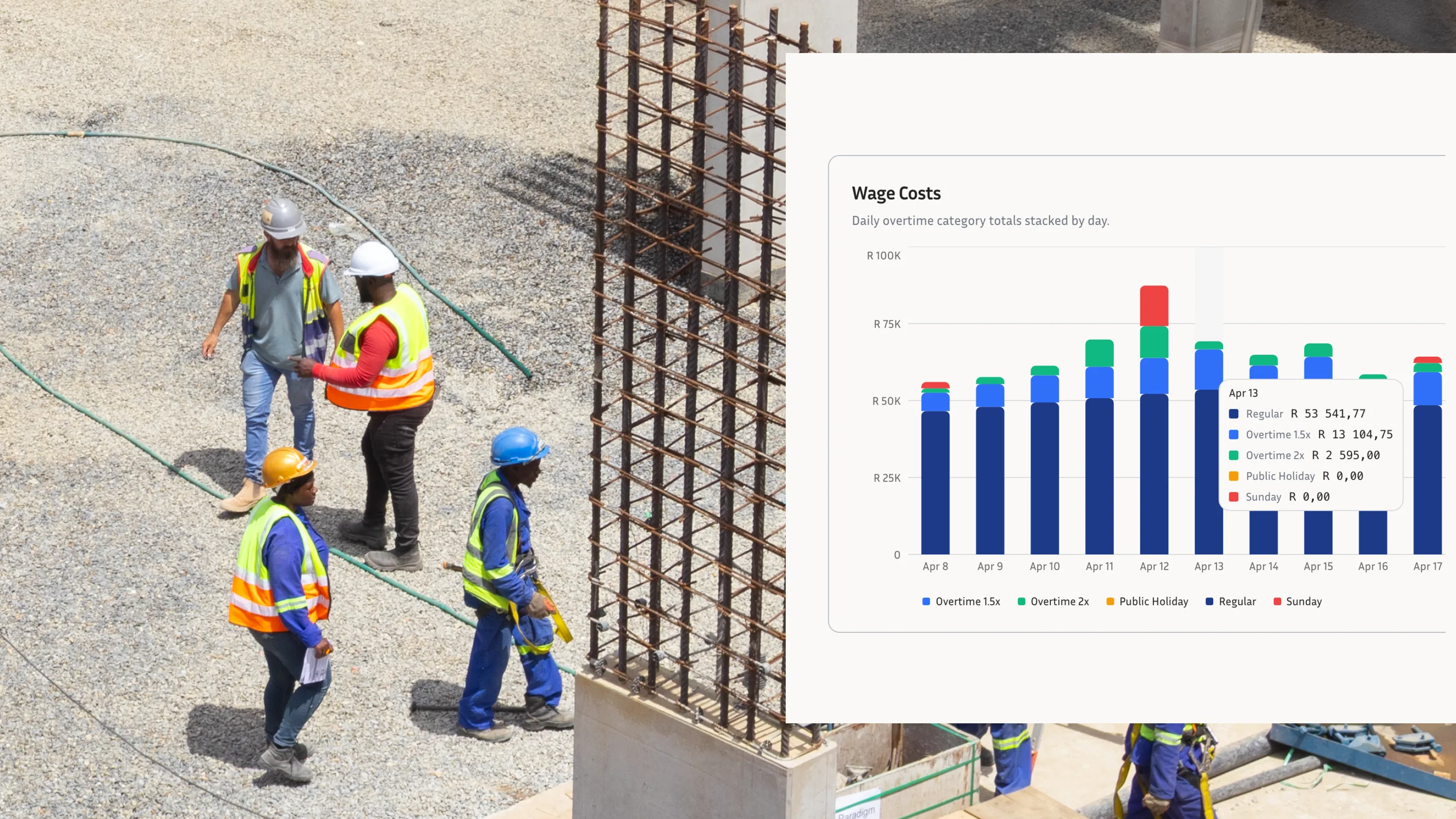
The immediate impact of reclassification lands on payroll. Workers who are reclassified must be added to payroll and processed with PAYE, UIF, and SDL deductions. If you have been paying a flat daily rate to workers running 10-hour shifts, that rate may not have covered overtime correctly. The overtime rate south africa mandates under the BCEA is 1.5 times the ordinary hourly wage for the first ten overtime hours per week, with double time applying on Sundays and public holidays. Getting those calculations right manually is slow and error-prone.
A built-in overtime calculator inside your time and attendance software removes the guesswork. When your clocking system records actual hours and your payroll engine applies the correct BCEA multipliers automatically, the risk of underpaying reclassified workers or overpaying contractors drops sharply. Without that automation, someone is doing the maths on a spreadsheet at the end of each month, and the chances of an error finding its way to the CCMA are high.
Leave entitlements create a second layer of cost. Every reclassified employee accrues annual leave at a minimum of 21 consecutive days per leave cycle, or one day for every 17 days worked. If your business has been operating without a proper leave tracker or leave management system for these workers, you will need to reconstruct leave balances from the point reclassification is established. An annual leave calculator south africa that operates within a BCEA-compliant framework takes this calculation off whoever is managing it manually on a spreadsheet.
The broader question is whether your hr software south africa can handle the transition. Many construction businesses still rely on manual timesheets and basic accounting packages for their labour records. Those tools do not produce the kind of auditable, timestamped records that hold up when a reclassified worker takes a dispute to the CCMA. What was acceptable as a contractor management approach is no longer sufficient once employees are involved.
Getting Your Clocking System Ready for the Shift
Time records are the foundation of compliance. The BCEA requires employers to maintain accurate records of hours worked for every employee. For reclassified workers, that requirement applies from the point reclassification is established. If you have had no formal clock in systems in place for workers classified as contractors, the absence of records puts you in a weak position in any dispute.
Construction sites have specific demands that a standard office clocking system cannot meet. Workers arrive at different times, shifts vary by project phase, sites change, and connectivity is often unreliable on remote locations. A reliable clocking system for employees in construction needs to be simple for workers on the tools to use, capable of running across multiple locations, and able to hold data securely when a network is unavailable.
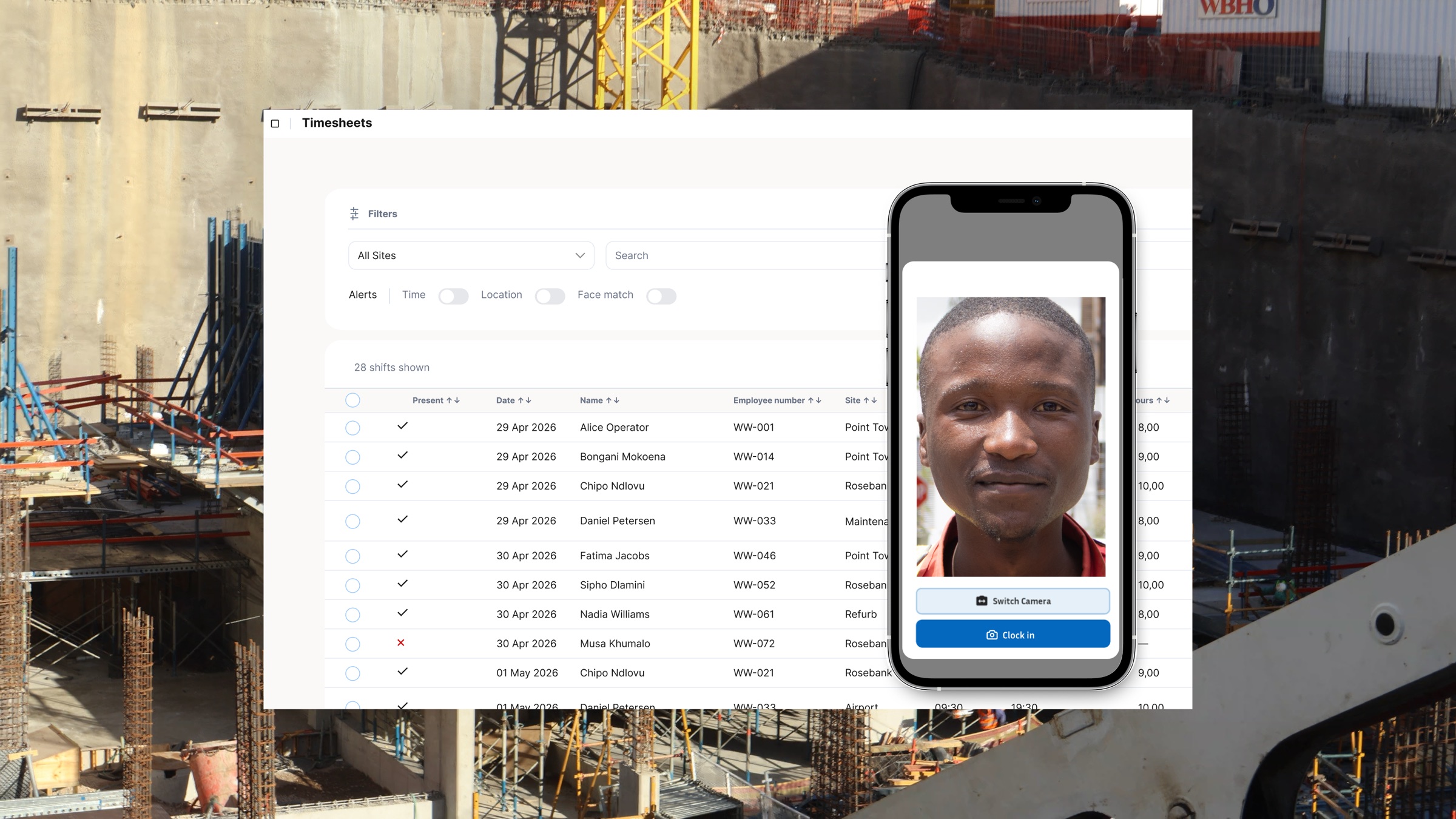
Biometric clocking has become the standard for serious site management. Each clock-in is tied to a specific person's biometric identity, which eliminates the buddy punching problem that inflates hours and corrupts payroll records. Facial clocking takes this a step further: the system uses facial recognition at the point of entry, so workers do not need to carry cards or touch shared surfaces, and there is no hardware to damage or lose on a busy site. As many South African construction managers have discovered, software-based facial clocking outperforms traditional biometric hardware in both durability and accuracy across multiple sites.
A proper employee clocking system also creates an audit trail that protects both the business and the worker. If a reclassified worker later claims they worked overtime hours that were not compensated, your timestamped attendance records give you a factual basis to respond. Without that record, the CCMA will generally favour the worker's version of events.
For businesses running multiple sites, workforce management software that consolidates attendance data across locations is not optional. You need to know who is on which site, what hours they have recorded, and how their total weekly hours track against your BCEA obligations in real time. Multi-site management built for construction gives you that visibility without requiring a separate admin person on each site to chase paper timesheets at the end of the week.
WorkWeek was built specifically for labour-intensive, multi-site environments in South Africa. The attendance management system runs without data connectivity, which matters enormously on remote construction sites. Workers clock in via facial recognition on a site tablet, and records sync when a connection becomes available. Accurate time tracking in South Africa that produces payroll-ready attendance records closes the gap where most compliance errors occur.
The Steps to Take Before the Amendment Takes Effect
Start with an honest audit of your contractor arrangements. Go through every person on your sites who is classified as an independent contractor and apply the LRA presumption test to the actual substance of the relationship, not the contract. If they work under supervision, use your equipment, and show up on your sites daily, the reclassification risk is real and you should treat it accordingly.
Then get your time recording in order. Every person on your site should be clocking in and out with a system that produces tamper-proof, timestamped records. A timesheet app that workers complete manually at the end of the day is not reliable enough for the standard the CCMA will apply. A digital attendance management system with biometric or facial verification is.
Review your payroll software south africa to confirm it can handle BCEA overtime calculations, leave accrual, and statutory deductions for workers moving from contractor status to employee status. If your current system requires manual intervention for these calculations, you are carrying unnecessary risk every pay cycle. Automating those calculations before reclassification happens is far cheaper than correcting errors after the fact.
The national minimum wage increases that took effect in 2026 already changed the cost base for construction labour. You can find a full breakdown of those changes and their practical implications in the national minimum wage 2026 guide for construction. Worker reclassification adds another layer to the same compliance picture, and the two changes interact: minimum wage floors apply to reclassified employees from day one, along with the overtime obligations that come with them.
Speak to a qualified labour attorney about the specific contractor arrangements on your sites. The legal exposure varies depending on how those arrangements are structured, and the amendment may have different implications for different types of subcontracting. What this article addresses are the operational and systems implications, not legal advice.
Construction businesses that sort out their time records, payroll systems, and compliance frameworks now will not be scrambling when the amendment takes effect. The reclassification test is not new. The penalty for getting it wrong is not new. What is changing is the pace of enforcement and the difficulty of mounting a defence without solid, timestamped records behind you. If you want to see how WorkWeek handles time tracking, attendance management, and multi-site compliance for construction businesses, talk to the sales team and find out what it looks like on your sites.