South African construction contractors run on margins that leave no room for invisible losses. Most project managers know about material overruns and equipment downtime. Fewer track what walks out the door through inaccurate time recording. Industry estimates put coordination-related wastage on construction sites at anywhere between 10% and 30% of project costs, and inaccurate clocking sits quietly at the centre of that problem. This article breaks down what GPS-verified clocking actually does differently from traditional clock-in systems, across the real scenarios South African site managers face every day.
What Traditional Clocking Looks Like on South African Construction Sites
"Traditional clocking" covers a wide range. On some sites, it means a paper register at the site office gate. On others, it means a supervisor with a clipboard walking the site at 7 a.m. and ticking names. Some businesses have moved to a basic biometric clocking system, a fingerprint reader mounted on a wall at the main entrance.
Each of these approaches shares the same structural problem: they rely on a single fixed point of presence verification. A worker taps in at the gate, and the system assumes that worker is on site and productive for the rest of the shift. What happens between clock-in and clock-out is invisible.
Paper timesheets carry a further problem. They require someone to capture that data manually into a payroll system, and manual capture introduces transcription errors. A foreman marks 9.5 hours; the admin clerk types 9 hours or misreads the handwriting as 9.5 when the actual figure was 8.5. Small discrepancies compound across a crew of 40 people over a month. By the time payroll runs, the errors are baked in.
Biometric clocking improved on paper, but only at the entry point. If your site has one biometric terminal and three active work zones spread across a hectare of ground, you still cannot verify where workers are once they've clocked in. You also cannot manage multi-site crews from a single view. Supervisors at each location keep their own records, and consolidating those records at the end of a week requires phone calls, WhatsApp messages, and manual cross-referencing.
For a fuller breakdown of how biometric hardware compares to GPS-based mobile clocking on construction sites, the WorkWeek vs biometric hardware comparison covers the practical differences in detail.
Where the System Breaks Down: Buddy Punching, Ghost Hours, and Multi-Site Blind Spots
Buddy punching is the most talked-about time fraud on construction sites, and for good reason. When a worker is late or absent, a colleague clocks in on their behalf. With a paper register, this requires nothing more than signing another person's name. With a basic punch card system, it requires the physical card. Even with fingerprint biometrics, workers have been known to coach colleagues through the system when terminals malfunction or when supervisors look the other way.
Ghost hours are subtler. A worker clocks in at 6:45 a.m., spends 45 minutes at the site canteen, and begins actual work closer to 7:30 a.m. At the end of the day, the system records a full shift from 6:45 a.m. to 4:30 p.m. The supervisor does not always see this. On a 50-person site, if 10 workers arrive and ghost 30 to 45 minutes per day across a five-day week, that is between 25 and 37.5 lost productive hours per week, hours that still attract wages and, if the shift extends, overtime.
Overtime is where the cost compounds fastest. South African labour law under the BCEA generally sets overtime at at least 1.5 times the ordinary rate for covered employees once daily or weekly ordinary-hour limits are exceeded. An inaccurate clocking system for employees that cannot distinguish between genuine overtime and inflated hours will systematically overpay. The 2026 BCEA earnings-threshold increase means more employees may fall within the working-time protections, which raises the stakes further for getting time records right.
Multi-site operations add another dimension. A contractor running three active sites with shared labour pools needs to know which workers are where at any given time. Traditional clock-in systems cannot answer that question in real time. Supervisors estimate. Payroll captures what supervisors reported. The result is that the same worker can appear on two sites' records for the same half-day, or workers who moved between sites partway through a shift get recorded on the wrong cost code entirely.
What GPS-Verified Clocking Changes in Practice
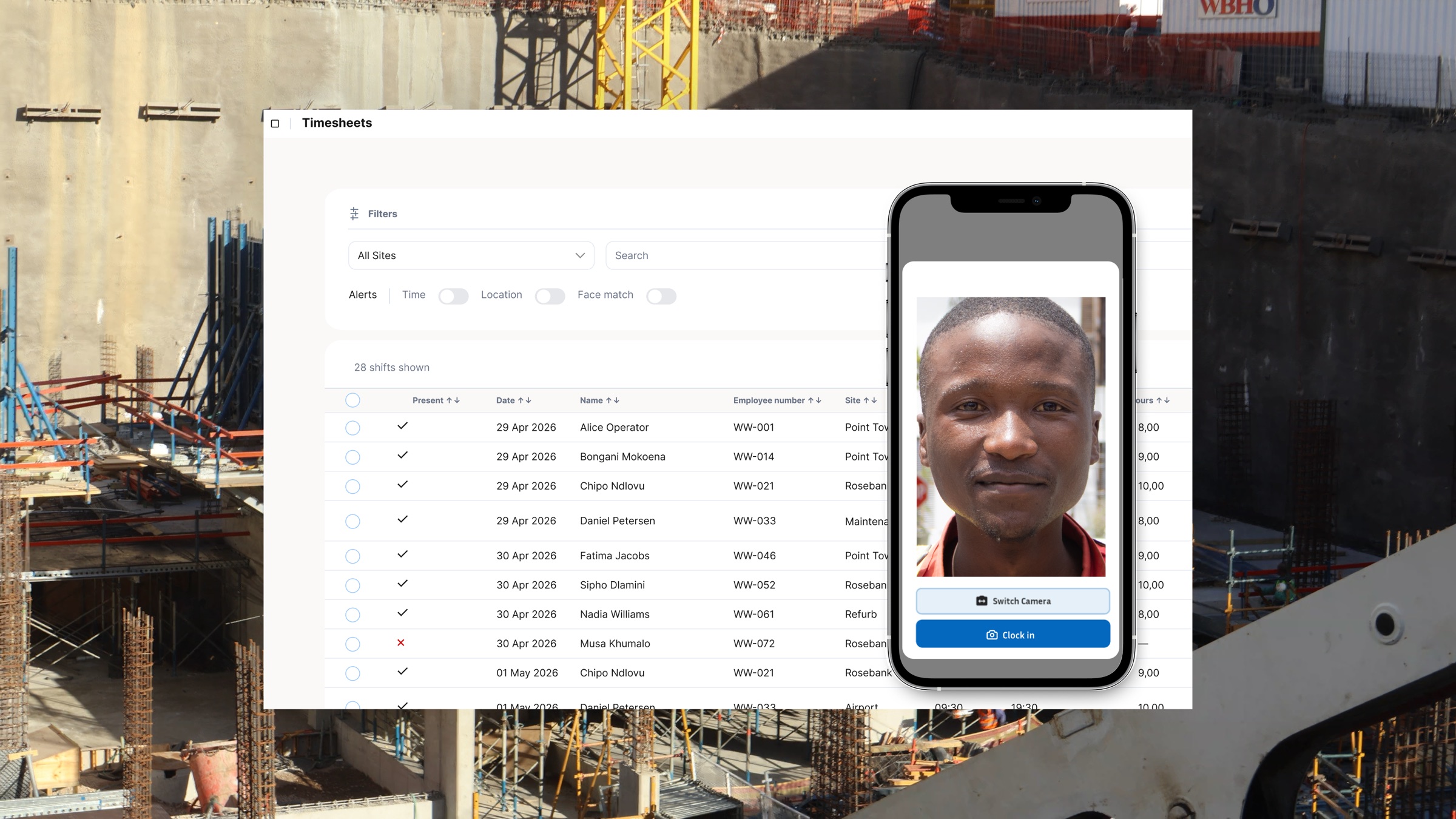
GPS-verified clocking ties each clock-in event to a specific geographic location. When a worker opens the app and registers their start time, the system captures not just the time but the coordinates. The site manager sets a geofence, a defined radius around the site boundary, and the system only accepts clock-in events originating from within that boundary.
This changes three things immediately.
First, it eliminates remote buddy punching. A colleague cannot clock someone in from a different location. The clock-in has to happen at the actual site. Combined with employee authentication features such as facial recognition at clock-in, the verification becomes more direct: the right person, at the right place, at the right time.
Second, it gives site managers visibility across multiple sites from a single view. A contractor with crews at a road rehabilitation project in Kempton Park and a substation upgrade in Midrand can see both in real time on the same workforce management dashboard. When labour moves between sites, the location record follows. Cost code allocation becomes accurate because the system knows where the hours were worked.
Third, it creates a payroll-ready audit trail. Every clock-in, clock-out, and break event is timestamped and location-verified. When payroll runs, the verified records are already structured for review instead of being reconstructed from handwritten timesheets. An overtime calculator can use those verified hours, apply the correct BCEA rate, and flag anomalies before payment is approved. This is particularly relevant for seasonal staff brought on for large contracts; accurate records from day one reduce the disputes that typically arise at contract end.
For remote site teams working on pipeline, road, or telecoms infrastructure, GPS clocking is often the only practical option. A site 60 kilometres outside the nearest town cannot have a biometric terminal installed and maintained. A mobile clocking system that works on a basic smartphone, and that can operate on data-free infrastructure for workers without connectivity, solves the access problem without sacrificing verification standards. The WorkWeek data-free time tracking approach is built specifically for this context.
A useful implementation test is simple: can payroll trace a disputed hour back to a timestamped event, a verified employee profile, and the site where the work was meant to happen? If not, the clocking process is still relying on trust where it needs evidence.
Cost-Benefit Breakdown: Running the Numbers
A crew of 40 workers on a six-month contract gives a concrete frame for comparison.
If buddy punching and ghost hours account for an average of 30 minutes of unearned pay per worker per day, five days a week, that is roughly 433 unearned ordinary hours a month across the team. At the 2026 national minimum wage floor of R30.23 per ordinary hour, the wage overstatement is about R13,100 per month. Over six months, that is about R78,600 lost to time fraud before any overtime miscalculation is counted.
Traditional clocking systems typically come with lower upfront costs. A basic biometric terminal costs between R2,500 and R8,000 per unit, plus installation. Paper registers cost almost nothing. But neither captures the cost of payroll errors, dispute resolution, or the hours supervisors spend reconciling inconsistent records at month-end.
A GPS-enabled attendance management system requires no hardware installation at fixed points. It runs on devices workers may already carry. Monthly per-user costs for quality time and attendance software range from R50 to R150 per employee depending on feature tier. For 40 workers, that is R2,000 to R6,000 per month, a cost that is recoverable if the system closes even 20% of the ghost hour gap described above.
The secondary savings come from payroll accuracy. When verified hours are available as export-ready payroll records, the risk of manual transcription errors drops significantly. Contractors using structured time records report fewer retroactive payroll corrections, fewer disputes from workers who believe they were short-paid, and shorter month-end admin cycles. That last point matters for small contractors where the owner or ops manager is doing payroll themselves alongside everything else they manage.
A Decision Framework for Site Managers
The choice between traditional and GPS-verified clocking is not always straightforward. Here are the conditions that should push you toward GPS-based clock in systems.
You run crews across more than one site. If labour moves between locations, or if you need consolidated attendance data from multiple sites, a mobile GPS system gives you a single record without manual aggregation.
Your site is remote or temporary. Fixed biometric terminals require power, installation, and maintenance. A GPS app on a smartphone works anywhere there is a signal, and data-free options extend that further.
You have experienced payroll disputes or suspected time fraud. If you cannot reconcile what workers claim they worked versus what supervisors recorded, GPS timestamps create an objective third record that is harder to dispute.
Your payroll software is still receiving manually captured hours. Any time a human transfers timesheet data into a payroll system by hand, you carry transcription risk. Export-ready GPS clocking records reduce that manual retyping step and make disputed hours easier to trace.
Traditional systems still make sense in a narrow set of circumstances: a single permanent site with consistent staff, stable power supply, strong supervisor coverage, and no multi-site complexity. In those conditions, a biometric clocking system at the entrance handles verification adequately.
For most contractors operating at scale across South Africa, particularly those managing seasonal labour, project-based crews, and remote sites, GPS-verified clocking is not a premium upgrade. It is the more accurate and more auditable option, and accuracy in time recording is the foundation that everything downstream, including payroll, compliance, and project costing, is built on.
If your site is still running on paper timesheets or a single biometric terminal, the gap between what you are paying and what you are actually getting in productive hours is probably larger than your last audit revealed. See how WorkWeek handles time recording across multi-site construction operations and get a clear picture of what accurate clocking can recover for your next contract.