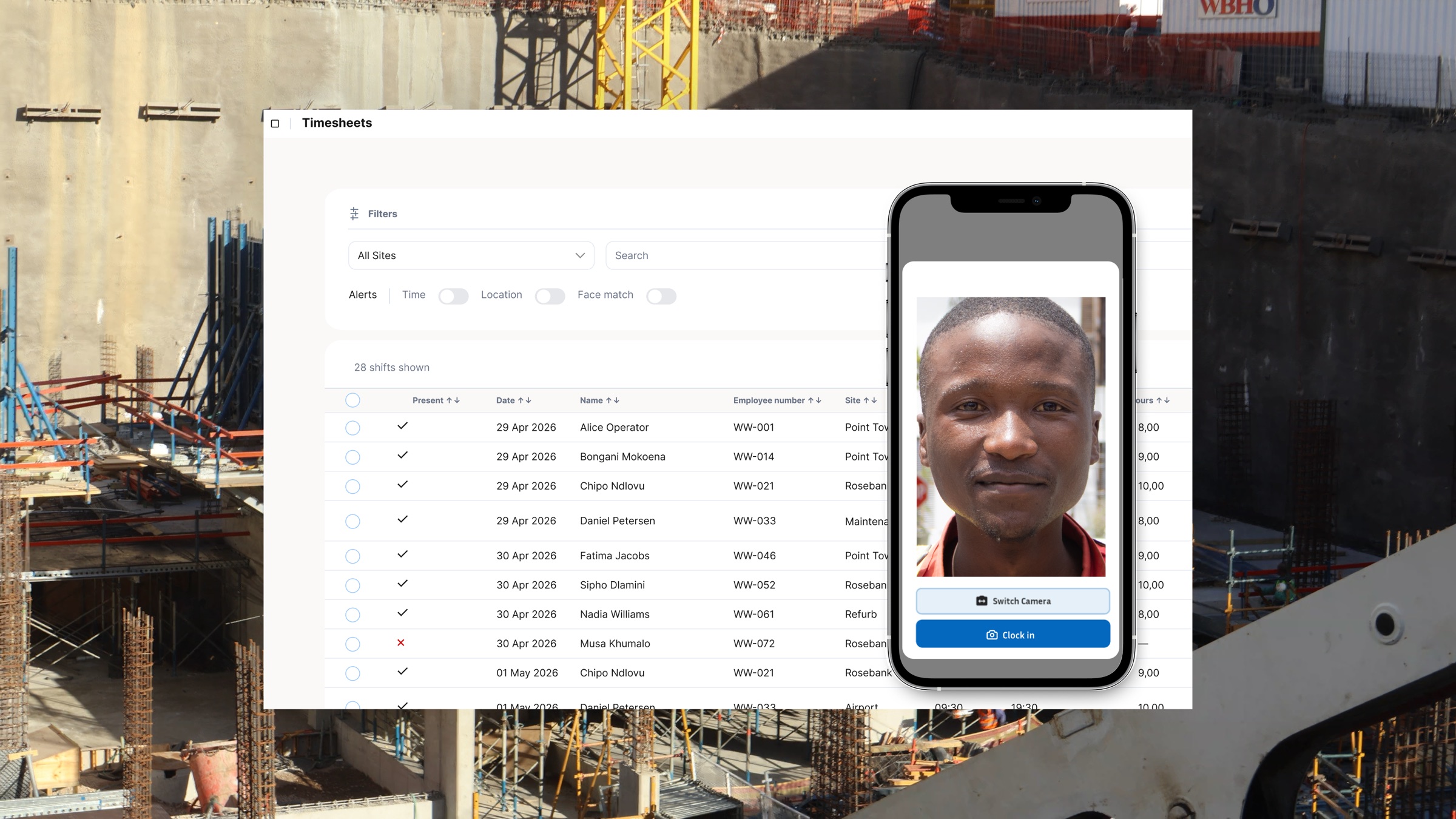
Yes, you can use GPS to verify employee clock-ins, and more South African construction businesses are doing exactly that. GPS verification checks whether the worker clocked in from the actual site instead of from home, a taxi, or a neighbouring street. If your business has ever paid for hours that were never worked on site, this is one of the most direct ways to tighten the record.
What Counts as a False Time Entry
False time entries are not limited to obvious fraud. They include clocking in before arriving, clocking out after leaving, one employee clocking in on behalf of another, or a supervisor rounding hours from memory on a paper sheet. Each one creates the same outcome: payroll pays against a record the business cannot properly defend.
On construction sites, this usually happens because paper attendance records and manual sign-offs do not prove location. They only prove that something was written down.
How GPS Clock-In Verification Actually Works
At the moment of clock-in, the app records the worker's GPS coordinates and compares them to the site location or geofenced area configured in the system. If the clock-in happens inside the allowed boundary, the entry is accepted. If it happens outside the approved area, the system can flag it for review or reject it altogether depending on the setup.
That means the business is no longer relying only on a timestamp. It is recording a timestamp and a place. For multi-site employers, that difference is what makes the record useful later.
Why It Matters More on Construction Sites
Construction businesses often run several active sites at once, with supervisors stretched across projects and payroll depending on records that arrive days later. In that environment, a simple attendance mark is not enough. The business needs to know the worker was at the correct site when the shift started and ended.
That is especially important when a dispute reaches payroll, a client query, or the CCMA. If the employer can only show a handwritten time entry, the dispute becomes an argument. If the employer can show a verified clock-in with time and location, the record starts from a stronger place.
What GPS Can and Cannot Prove
GPS can prove where the device was when the worker clocked in or clocked out. It cannot, by itself, prove who held the device or what happened for every minute of the shift. That is why the best systems pair GPS with worker identity checks and a clean clock-out record, not GPS alone.
In practice, that means location verification works best when it sits alongside a worker profile, a verified clock-in process, and a proper audit trail instead of as an isolated pin on a map.
GPS verification is most useful when it is visible rather than hidden. Managers need to see location mismatches quickly, not discover them after wages have been paid or after a dispute has started.
Most importantly, look for identity verification alongside location capture. GPS confirms where the device was. Facial clocking or biometric verification confirms who used it. Together they create a complete attendance record.
What To Look For in a GPS Clocking System
- Offline capability so the record still works when the site loses signal
- Verified location checks against the approved site rather than a loose manual note
- Identity controls that reduce one worker clocking in for another
- A searchable audit trail the payroll or HR team can export later
- A process that can scale across multiple active sites without new hardware at each gate
Why the Payroll Team Cares Too
The Basic Conditions of Employment Act requires employers to keep written records of hours worked and overtime worked. GPS verification does not replace that obligation. It improves the quality of the source record that payroll relies on to meet it.
If the attendance record is weak at the start, every payroll correction later is weaker too. GPS clock-in verification helps stop that by making false time entries easier to spot before they become paid hours.
The Direct Answer
If you want to stop employees clocking in from the wrong location, GPS verification is one of the clearest fixes available. It does not solve every attendance problem on its own, but it gives construction businesses a much stronger first record than paper timesheets, WhatsApp check-ins, or trust-based sign-off ever can.