Ghost employees bleed payroll budgets quietly. A foreman submits 18 names on Friday's timesheet, payroll processes 18 wages, but only 15 people worked that week. Three names on that sheet either walked off the project months ago or never existed, and without a clocking system that connects physical presence to payroll records, nobody catches it. By then, the money is already gone.
How Ghost Employees Get Onto Your Payroll in the First Place
Ghost workers come in three forms, and each exploits the same weakness: the gap between what a paper register says and who was actually on site.
The stale entry is the most common. A worker leaves your project without a formal exit process, but nobody removes them from the attendance register. Their hours keep getting logged, and your payroll software South Africa team processes their wages every week without question. This pattern is common at large sites where the person managing attendance is different from the person running payroll, and where no automated system flags workers who have not clocked in for two weeks.
The fictitious entry is deliberate fraud. A name is added to the timesheet that never belonged to a real worker on your site. It requires access to the attendance register or payroll data, and it is structurally impossible to prevent with paper. A foreman or site clerk adds the entry, redirects the wage, and the numbers look plausible against the daily headcount.
The third pattern is the inflated-hours ghost: a real worker whose attendance record is padded. Someone clocks them in on days they were absent, or adds extra hours to every shift. The worker exists, the employment relationship is real, but the hours are fiction.
Why Paper Timesheets Create the Conditions for Payroll Fraud
A paper timesheet asks you to trust every person in the chain, from the foreman who fills it in to the clerk who transfers it to the administrator who enters it into payroll. None of those steps has an independent verification check. A name on a sheet proves nothing about whether that person stood at the site gate that morning.
A timesheet app that still relies on manual input carries the same weakness, regardless of whether the form is physical or digital. If anyone can add a name or change a number without it being verified against a real clock-in event, the fraud risk remains. The problem is the structural separation between the record and the physical person it claims to represent.
Multi-site construction operations compound this. Running three or four active sites means trusting each site's foreman to submit accurate attendance data, with no cross-site system-level check on any of it. BCEA Section 31 requires employers to keep time-worked and remuneration records for three years, and the employer carries the burden of proof in any CCMA dispute. Paper records assembled from memory do not hold up well at a hearing.
An attendance management system built on paper also gives your payroll team nothing to cross-reference. When a name appears on a weekly timesheet with no digital clock-in record behind it, there is no automated flag, no location stamp, and no biometric match to verify the entry against. The fraud moves through unchallenged.
How a Biometric Clocking System Removes the Manipulation Point
A biometric clocking system changes the verification source entirely. Instead of trusting a person to write down who was present, the system requires the worker's body to confirm their own presence at the moment of clocking.
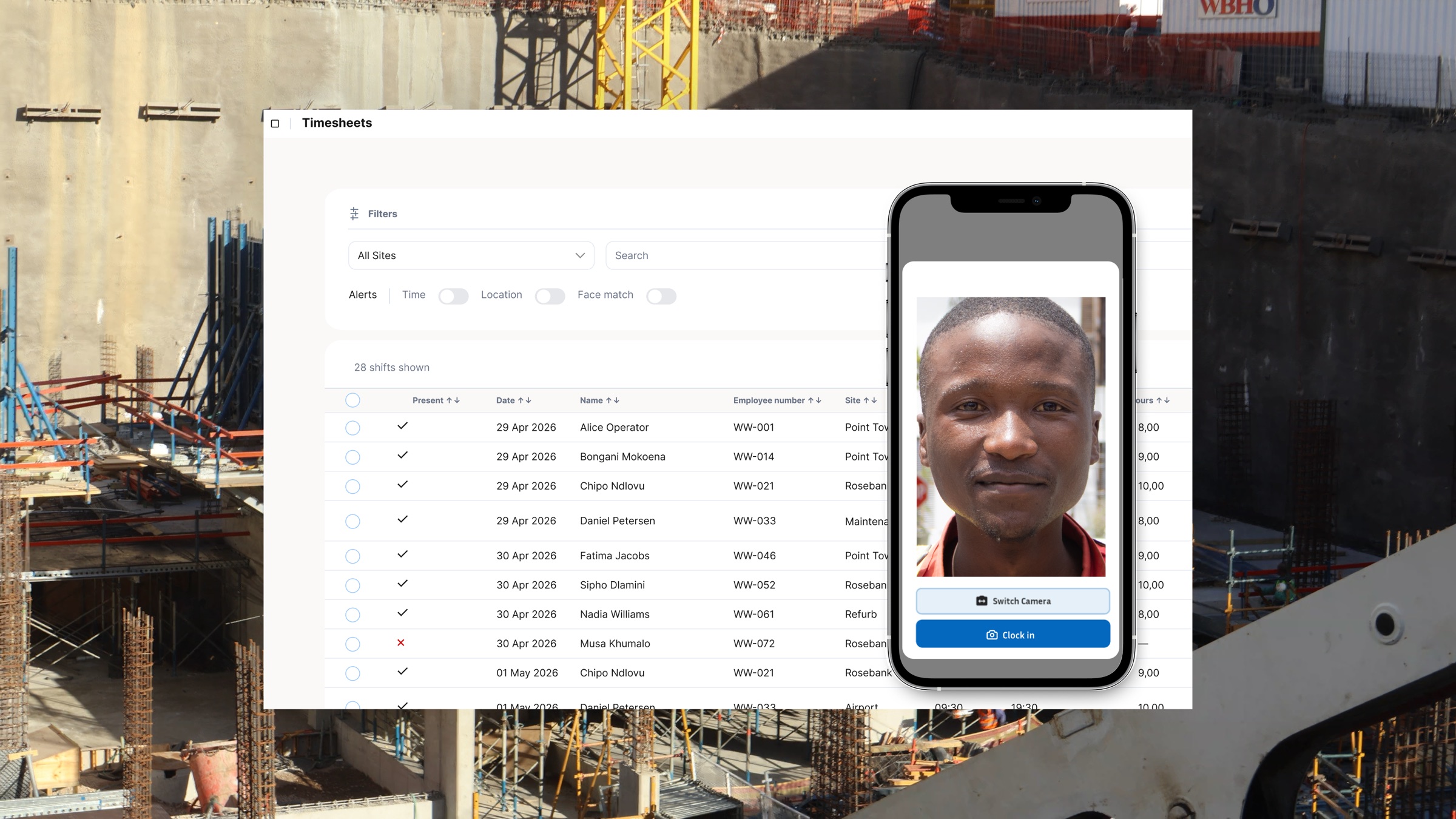
Facial clocking is the most practical form of biometric verification for construction sites. The worker takes a selfie at the site entrance, the record is checked against an enrolled profile captured at onboarding, and failed or missing verification becomes visible before payroll is approved. A ghost employee cannot pass this check. A worker who left three months ago has no active profile in the system.
WorkWeek's facial clocking runs from a smartphone or tablet placed at the site gate. Records store locally when there is no internet connection and sync automatically when connectivity returns, which matters for remote or rural construction sites where data coverage drops out regularly. You can see exactly how this works on the employee authentication feature page.
This shift also removes the foreman from the sole position of authority over attendance data. Nobody should be the single verification point in a payroll process, and a biometric clocking system for employees makes it structurally impossible for one person to introduce ghost entries without the system catching it.
Connecting Verified Clocking Data to Payroll Software South Africa Teams Already Use
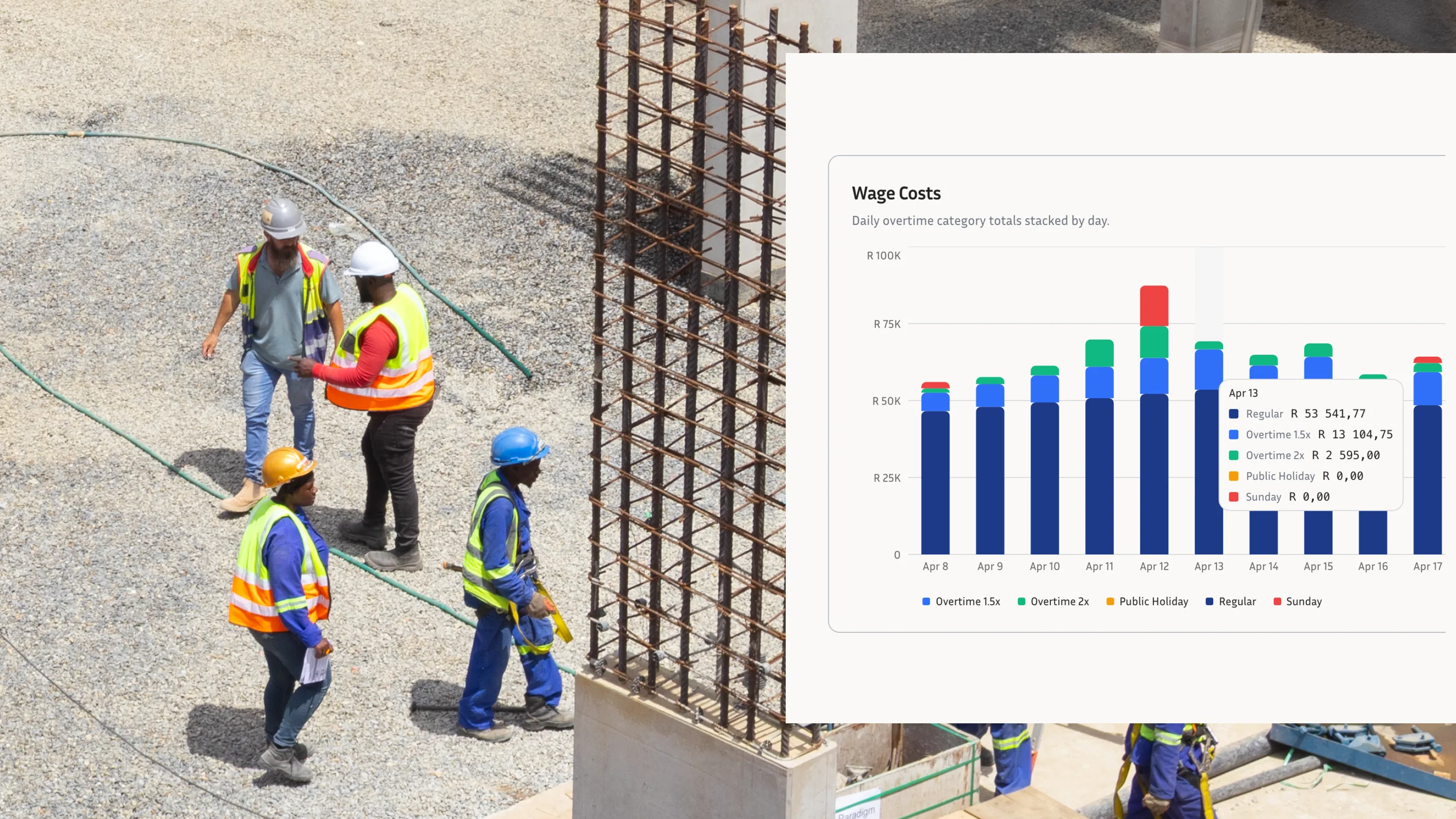
Ghost employees are a data quality problem before they are a fraud problem. Payroll software South Africa platforms process what they receive. Clean, verified attendance data produces accurate payroll. Inflated paper timesheets produce inflated wages, and the software executes every fraudulent entry faithfully.
An employee clocking system that produces payroll-ready verified attendance exports reduces the manual data entry step substantially. The record payroll teams review is the exact record the worker created when they physically clocked in and out, not a reconstructed version of what a supervisor remembers. There is no spreadsheet between the site and the payroll run that anyone can quietly edit.
WorkWeek gives payroll teams export-ready verified hours for systems such as SimplePay and Sage, two widely used payroll platforms in the South African construction market. Site managers see verified hours per worker per day on a live dashboard, review the data before exporting, and catch anomalies before they become payroll errors. The payroll accuracy article for SA construction contractors covers the downstream financial cost of skipping this step.
A reliable employee clocking system also produces a three-year BCEA-supporting audit trail that labour inspections and payroll reconciliations can use. Timestamped, GPS-confirmed clock-in records are a fundamentally different compliance position from a filing cabinet of handwritten sheets that nobody can independently verify.
What Ghost Workers Actually Cost a Construction Business
The numbers are not complicated. One ghost worker paid at the 2026 national minimum wage for a standard 45-hour week costs roughly R5,200 per month. Two ghost workers cost R10,400. On a 50-person site, even 4% payroll fraud running undetected for a full year costs over R250,000 before anyone identifies it.
That is the direct cost. An attendance management system that is not connected to verified clock-in events creates three additional liabilities simultaneously: CCMA exposure when a real worker disputes their hours and your records were assembled manually, SARS penalty risk when payroll reconciliations are rejected because the data does not match, and reputational damage on a government contract when a labour inspection surfaces inflated headcounts.
The management cost compounds the financial one. Every hour a site manager or payroll administrator spends reconciling anomalies, re-checking timesheets, and chasing attendance queries is time not spent running the site. A workforce management software solution that automates verified attendance capture and keeps clean data ready for payroll review does not just close the fraud gap. It returns those hours to productive use.
For a direct comparison of what verified clocking prevents versus what traditional systems miss, the guide to stopping buddy punching on SA construction sites covers the overlapping fraud patterns in full detail.
What to Require From a Clocking System for Employees
Not every clocking system for employees closes the ghost employee gap. A timesheet app that still relies on supervisor sign-off or manual approval recreates the same verification problem as a paper register. The requirement is that the clock-in event itself must be anchored to a verified identity, with no human intermediary who can add or alter entries before they reach payroll.
The clocking system for employees that closes this gap needs four things: identity verification evidence via facial clocking or biometric verification, offline functionality for sites where data coverage is unreliable, GPS confirmation that the worker is at the correct location, and payroll-ready exports that reduce manual data entry between attendance and payroll. If any of those four are missing, the fraud risk stays open.
An attendance management system that delivers all four creates a payroll-supporting attendance record that no single person can manipulate from outside the system. It also produces the kind of time and attendance software audit trail that supports labour inspections, payroll reconciliations, and CCMA disputes. That is the standard worth holding your next clocking system to, and you can compare how different systems perform against it in the full clocking system guide for South African businesses.
Ghost employees do not survive the shift from paper to verified clocking. A biometric clocking system that requires facial verification evidence at the site gate makes fictitious entries structurally difficult and stale entries immediately visible on your attendance dashboard. Combined with payroll-ready exports for the payroll software South Africa construction businesses already run, verified attendance data removes the manipulation risk before it reaches your payroll run. WorkWeek builds exactly this for South African construction and labour-intensive businesses. To see how your site attendance data would look without the fraud exposure, book a demo and we will walk you through it.