South Africa's infrastructure pipeline is the biggest capital injection the construction sector has seen in over a decade. Public-sector infrastructure spending over the 2026 medium-term expenditure framework is estimated at about R1 trillion. That growth brings contract wins, crew expansions, and new site setups. It also brings a payroll compliance burden that most construction businesses are still trying to manage on spreadsheets and paper registers.
The Maths Behind the Pipeline
Roads, energy, water, logistics, and social infrastructure represent a sustained pipeline, not a single tender cycle. Construction businesses that had 50 workers on the books in January 2024 should be planning for much larger crews by mid-2026 if they are winning their share. That growth is not linear at the payroll level. Every new hire brings a TRN registration obligation, a BCEA classification check, a leave entitlement, and in most cases an overtime agreement.
The businesses falling behind are the ones treating payroll as an administrative function that scales automatically with headcount. It does not. Manual payroll on paper timesheets worked when one site manager knew every worker by name and kept a running tally. With 75 workers across four sites and new hires every month, that model produces errors, and errors on construction payroll are expensive.
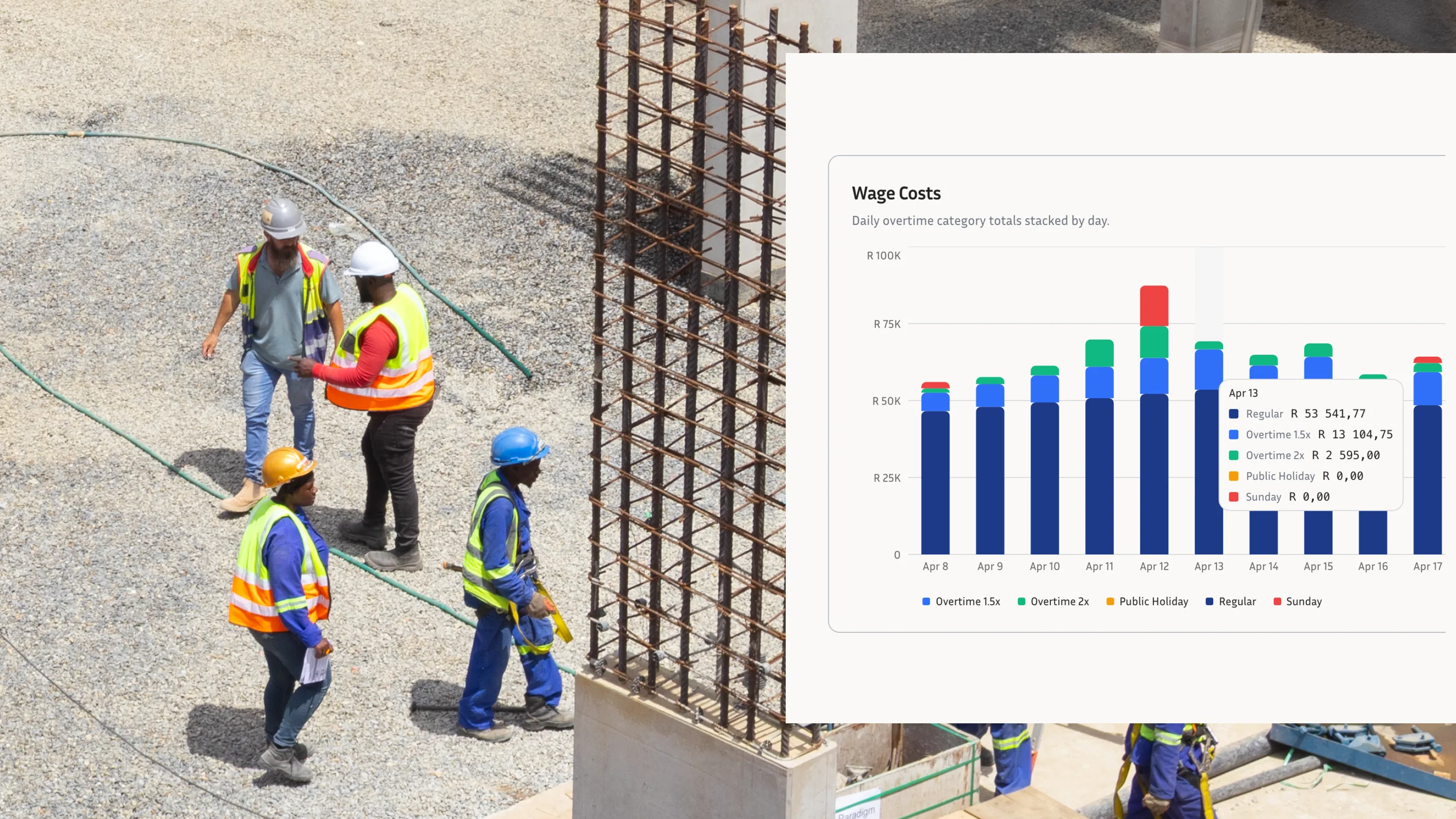
Labour cost per project south africa reporting is one of the most important figures a project manager needs to track. When time records are inaccurate, that figure is guesswork. Guesswork on a R50-million infrastructure contract means you are pricing the next bid without knowing whether the last one was profitable.
The businesses best positioned to capitalise on the infrastructure boom are not necessarily the largest ones. They are the ones with clean, verified time data that supports payroll-ready records, project codes, and compliance documentation. That is the operational infrastructure that payroll software south africa teams now need.
TRN Compliance Breaks When You Hire at Speed
SARS's enforcement focus on Income Tax Reference Numbers has made TRN registration a front-line payroll risk for any construction business hiring at pace. From the February 2026 employer filing season, employers cannot submit reconciliations without valid Income Tax numbers for employees who must have them. On a site where five casual labourers are being onboarded on a Monday morning to meet a subcontract deadline, TRN collection is often the last thing on the site manager's mind.
The problem compounds when growth requires rapid seasonal hiring. Rural workers entering formal employment for the first time, workers with informal work histories, and young apprentices starting their first registered job all fall into the TRN gap. You cannot complete a compliant EMP501 if your clocking data and employee register are not linked from day one of employment.
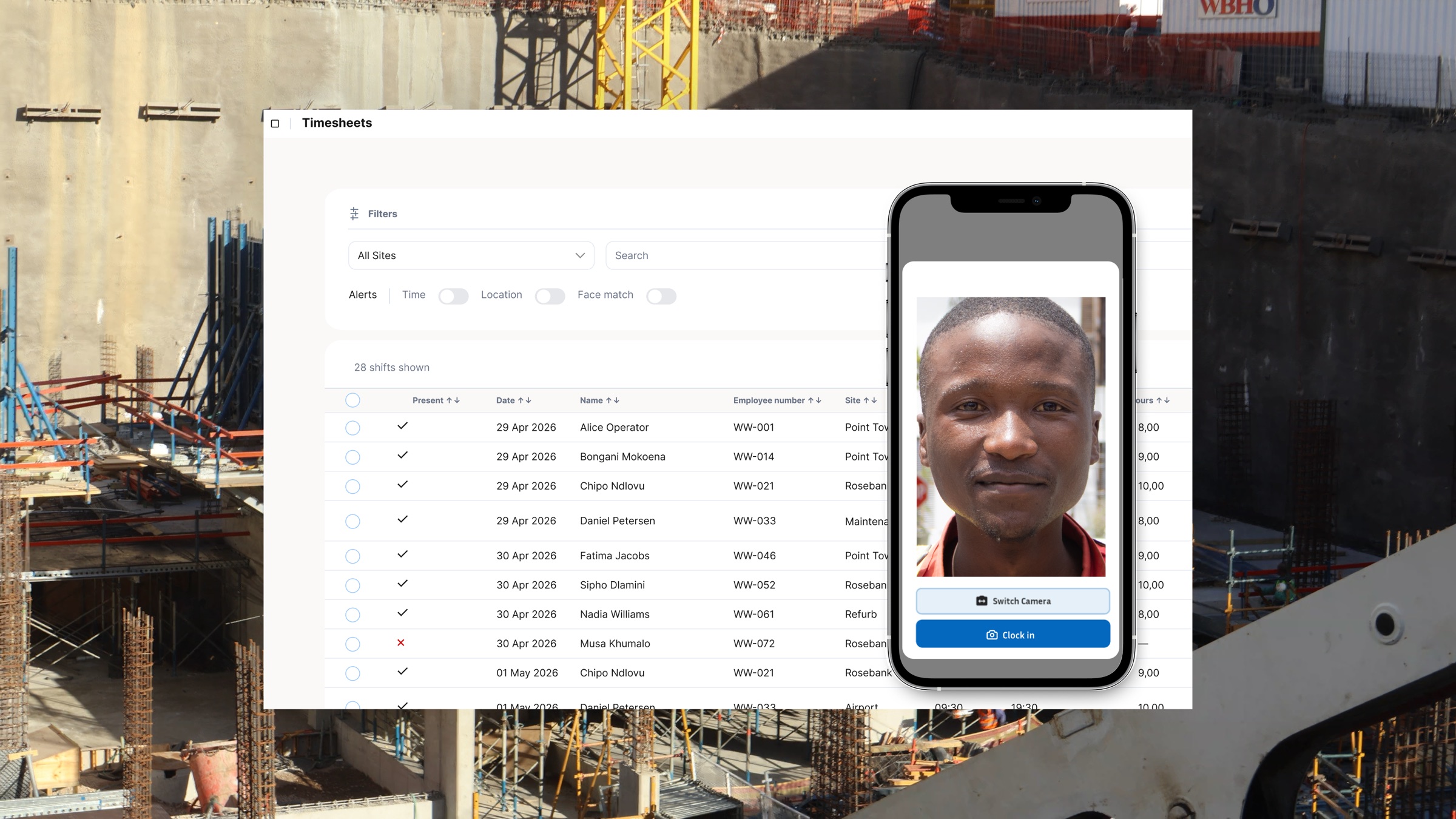
A proper clocking system for employees that ties clock-in access to a complete employee profile, including TRN status, catches these gaps before they reach payroll. Paper registers and spreadsheet-based attendance management systems do not. When a growing construction business is onboarding workers across multiple sites in the same week, the clocking system is the first place TRN gaps show up, and the last place you want to discover them is during a SARS audit.
Administrative non-compliance penalties under the Tax Administration Act can run from R250 to R16,000 per month, depending on the taxpayer's assessed loss or taxable income and the relevant incidence. Across a crew of 90 workers with 20 missing TRNs, the rejection and remediation risk is not theoretical.
BCEA Thresholds and Crew Sizes That Change the Calculation
The BCEA earnings threshold is R269,600.90 per year from 1 May 2026. Workers earning at or below this threshold are generally covered by statutory working-time protections, including overtime rules. When a business expands its crew, some workers cross the threshold as their wages and roles change. Others remain below it.
Managing this manually across a growing headcount is where overtime calculation errors become expensive. A leading hand earning R22,000 per month is below the threshold, while a senior foreman at R25,000 has crossed it. If your site manager does not know which crew members fall where, you are either underpaying overtime or applying entitlements that do not exist in statute. Neither outcome holds up when a worker takes a dispute to the CCMA.
The correct overtime rate in South Africa for any given construction worker depends on three things: the worker's gross earnings, whether a valid overtime agreement is in place, and accurate hours recorded per shift. None of those three things can be reliably determined from a paper timesheet reconstructed at the end of the week. An overtime calculator is only as useful as the time data feeding it, and time data from paper registers is almost always an approximation.
Construction time tracking south africa teams can trust means verified start and end times per worker, per site, and per shift. Without construction time tracking south africa records tied to payroll, the BCEA threshold becomes a guess. Guessing on overtime obligations is how construction businesses end up in disputes they cannot win.
Overtime Agreements and Section 197 Transition Risk on Growing Sites
BCEA Section 10 requires overtime agreements to be in writing, and some agreements concluded at the start of employment or during the first three months lapse after 12 months. That is manageable on a single site with 20 workers. Across six sites with 90 workers and regular crew rotations, agreement renewal becomes a real administration problem.
When a business grows from two sites to six in 18 months, agreements lapse unnoticed, workers keep clocking overtime, payroll keeps processing it, and nobody flags the expiry until a dispute lands. The financial exposure at that point can include back-payment of overtime at BCEA default rates, with interest.
Workforce management software that does more than track time, flagging agreement expiry dates, generating renewal reminders, and keeping documentation accessible when a CCMA dispute lands, is what growing construction businesses need. Workforce management software should make the renewal date visible before the risk becomes a payroll dispute.
Section 197 of the Labour Relations Act adds further complexity for businesses winning new infrastructure contracts on multi-site projects. When a new main contractor takes over a site, workers employed by the outgoing contractor may transfer automatically. If the incoming contractor does not have accurate records of those workers' hours, overtime obligations, and leave balances, they inherit liabilities they cannot quantify.
The HR software South African construction businesses use for Section 197 protection needs to cover three things: hours on record per worker, accrued leave balances, and overtime calculation history. Without those records, contractor transitions on major projects become expensive surprises that arrive months after a contract is signed.
Three Labour Bill Provisions Hitting Growing Businesses Hardest
Labour-law proposals published by the Department of Employment and Labour in 2026 would cut deepest for construction businesses expanding into the infrastructure pipeline, because proposed changes are harder to manage the faster a business has grown.
The first is guaranteed hours. If written guaranteed hours become mandatory for shift-based, casual, and on-call workers, construction businesses that currently hire day-labourers on vague standing arrangements will need to formalise what they are committing to. Scaling crew sizes for a new contract cannot rely on flexible informal arrangements to manage payroll costs. Every worker needs a documented commitment, and every hour worked against that commitment needs a verified record.
The second is severance exposure. If severance entitlement increases from one week to two weeks per completed year of service, a business that project-terminates 20 workers at the end of a 12-month road contract has to build that larger liability into the bid from day one. On a growing business carrying multiple site-term crews, annual leave calculations and severance projections need to feed from accurate time records, not end-of-project estimates.
The third is reclassification risk. Expanded employee-definition proposals target workers who were previously contracted as independent operators but have worked consistently within a single business's operations. A construction company using the infrastructure boom to win more contracts and pass labour to nominally independent gangs is exactly the scenario this provision targets.
All three provisions have a common thread: they hit hardest on businesses that have grown their workforce without building the documentation and record-keeping infrastructure to match. A business with 20 workers and clean records is manageable. A business with 90 workers, inconsistent contracts, expired overtime agreements, and paper timesheets is exposed on multiple fronts at once.
What Scaling Payroll Systems Actually Look Like
A growing construction business needs payroll software south africa operators can rely on for three specific things. It must capture verified hours per worker per site, with the identity confirmation that makes those records stand up at the CCMA. It must automate BCEA overtime calculations based on each worker's earnings threshold, so the overtime rate South Africa's labour law requires is applied correctly by default, not by manual checking. And it must produce audit-ready records in a format that satisfies SARS, the CCMA, and a Section 197 due diligence simultaneously.
The clocking system for employees at a site gate, whether facial clocking on a tablet or a dedicated biometric clocking device, is the starting point. Biometric clocking captures the identity confirmation that paper registers cannot. A biometric clocking system that works offline and syncs when connectivity returns is particularly important on remote infrastructure sites where data coverage is inconsistent. The time and attendance software downstream of that clocking system is what connects verified hours to payroll, project codes, and compliance documentation.
Multi-site management matters as much as the clocking itself. A leave management system and clock-in systems that give an operations manager a single view across all active sites, showing who is clocked in, what hours are accumulating per project, and which overtime thresholds are approaching, is what separates controlled growth from chaotic growth. A timesheet app that reconstructs hours after the fact is not the same as a system that records them as they happen.
Labour cost per project south africa reporting should come from the same verified records, not from a spreadsheet assembled after the contract manager asks for margin detail. Construction time tracking south africa teams use on site should therefore connect clock-ins, project codes, and payroll exports before weekly payroll is approved.
Conclusion
The R1-trillion infrastructure pipeline is a genuine opportunity. It is also pressure on payroll systems that were barely coping before the growth started. TRN gaps, BCEA threshold miscalculations, expired overtime agreements, and Section 197 transition risk are all solvable problems. What makes them unmanageable is scale, hiring speed, and manual processes that cannot keep up with either.
Payroll software south africa construction businesses can trust is not a luxury reserved for large civils contractors. Clean time tracking data, verified clock-in records that hold up in any dispute, and labour cost per project south africa visibility are all downstream of one thing: knowing exactly when each worker arrived, which site they worked, and how many hours they put in.
If your payroll system is still built on paper while your workforce doubles, the infrastructure opportunity carries more risk than reward. WorkWeek gives growing construction teams the workforce management software foundation to keep payroll, compliance, and site labour costs aligned as crews expand.