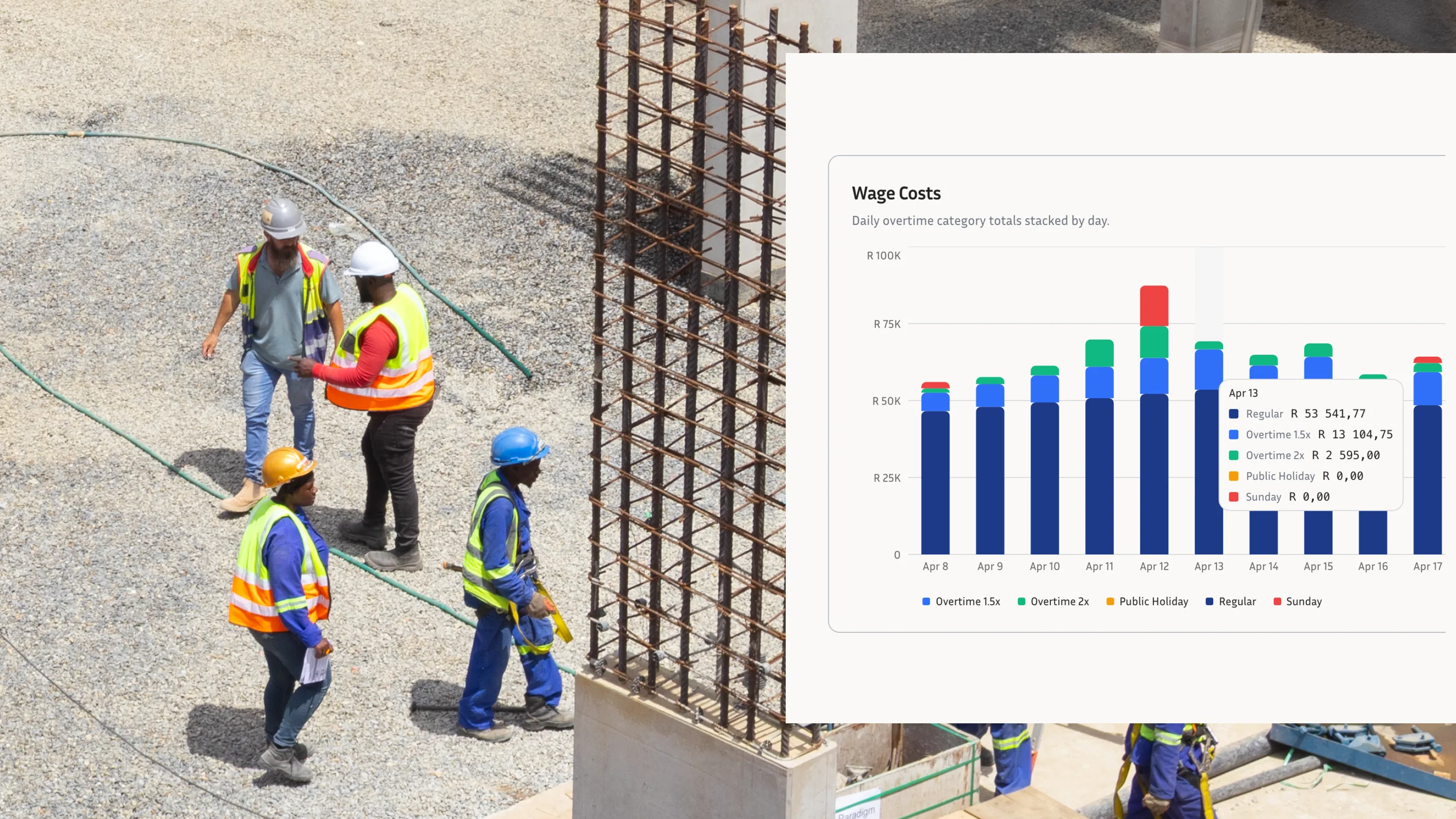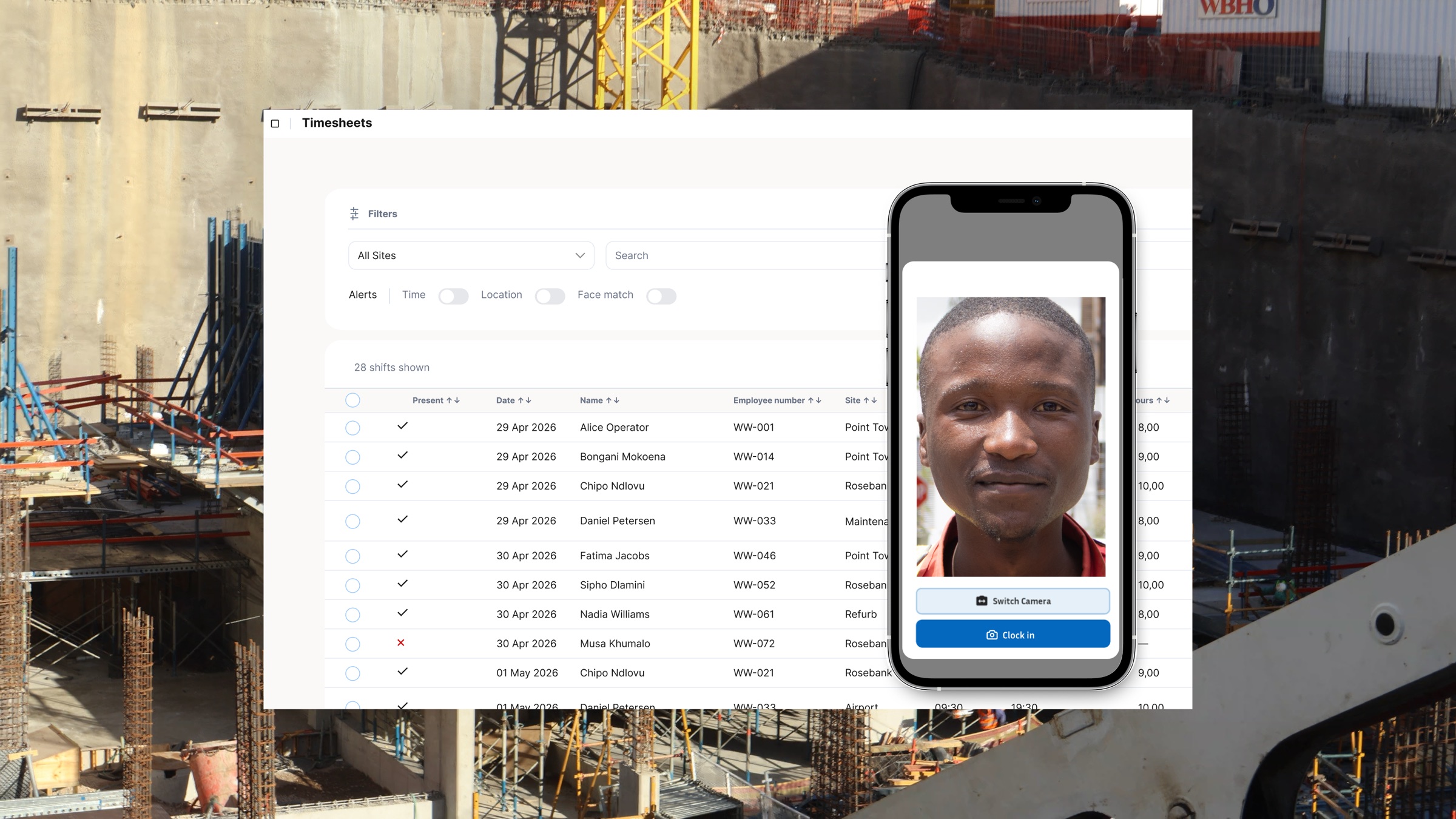
Buddy punching cost one South African civil contractor three weeks of payroll rework and R11,400 in overpaid wages before anyone spotted the pattern. The scam is simple: a worker who arrives late, or not at all, gets a colleague to clock in on their behalf. Without facial verification and GPS enforcement, the system records those hours as legitimate. On a crew of 50, just 15 minutes of ghost time per worker per day can add up to R9,446.88 in false wages every month.
What Buddy Punching Actually Costs
The R9,446.88 monthly figure is conservative. It assumes 50 workers, 15 minutes of false clocking per person per day, the 2026 minimum wage floor, and 25 working days in the month. Stretch that ghost time to 20 minutes, or run a crew of 80 instead of 50, and the number climbs fast.
The payroll cost is only the first problem. BCEA overtime calculations depend on verified daily and weekly hours. If a pay dispute reaches the CCMA, an employer with timestamped, identity-verified attendance records is in a stronger position than one relying on paper timesheets or unsigned registers.
Multi-site operations add another risk. A worker registered to Site A can record hours for Site B without ever setting foot there if the clocking system does not enforce location. Traditional biometric hardware can solve identity at a fixed terminal, but it does not always solve where the work was recorded.
The Five Features That Stop Buddy Punching
Not every clocking feature prevents fraud. Shift reminders, leave calendars, and export reports are useful, but they do not stop one worker clocking in for another. A proper employee clocking system needs five controls before it belongs on a construction shortlist.
- GPS geofencing restricts clock-ins to a defined boundary around each site, so a worker outside the boundary cannot clock in for that site.
- Facial or selfie verification matches the person clocking in against a registered profile, which directly blocks buddy punching.
- Offline mode records verified clock-ins locally when network coverage drops and syncs them later without creating a manual fallback.
- Low-data or data-free operation removes the pressure on workers to skip clocking or borrow data at remote sites.
- BCEA compliance automation connects verified hours to the right overtime, Sunday, public-holiday, and leave calculations.
A clocking system for employees on South African construction sites needs all five. An attendance management system that stops buddy punching but still leaves overtime calculations to a spreadsheet only solves half the problem.
8 Clocking Systems Ranked by Anti-Fraud Capability
The practical ranking is based on whether each tool can handle GPS geofencing, identity verification, offline work, low-data operation, and BCEA payroll fit in South African construction conditions.
- WorkWeek: 5/5. GPS geofencing, facial profile matching, offline sync, data-free operation, multi-site visibility, and BCEA-aligned payroll outputs.
- ERS Biometrics: 4/5. Strong biometric hardware and offline use, but fixed terminals can struggle with mobile or temporary sites unless the mobile app is part of the setup.
- Connecteam: 3/5. GPS and selfie features are useful, but offline reliability, USD billing, and no BCEA automation are meaningful limitations.
- Jibble: 3/5. Good free-tier GPS controls and facial recognition, but field enforcement and South African payroll fit need testing before rollout.
- Buddy Punch: 2.5/5. GPS and facial recognition are present, but live connectivity and USD pricing make it harder for remote South African sites.
- Deputy: 2.5/5. Strong scheduling and GPS features, but BCEA automation is missing and offline coverage depends on the device setup.
- Hubstaff: 1.5/5. Useful GPS tracking for field teams, but no facial verification and no BCEA compliance automation.
- Clockify: 1/5. Good for desk-based project time tracking, but not built for construction anti-fraud controls.
What South African Sites Need
Tools built for the US or Europe often include GPS and basic selfie clocking, but they miss the South African construction realities that matter most: offline operation, data-free clocking, and BCEA compliance. A site manager dealing with shared phones, weak LTE, and weekly payroll cannot afford two out of three.
The right attendance management system verifies who is clocking in, confirms where they are doing it, works when the network drops, and sends clean hours into payroll. A clocking system for employees that fails at any of those points leaves a fraud window open. That is why an employee clocking system should be judged by the payroll errors it prevents, not only by the feature list it advertises. If your attendance management system cannot prove those basics, the fraud risk remains inside payroll.
WorkWeek is built around that construction-site reality. It gives managers verified facial clock-ins, GPS enforcement, offline sync, and payroll-ready attendance data in one employee clocking system. If your current clocking system for employees cannot answer who, where, when, and what it means for payroll, it is worth running the fraud calculation against your own crew size.