Running a 24-hour construction site is a different compliance challenge from running a standard 45-hour work week. When shifts cross midnight, when crews rotate between days and nights, and when Sunday-rate calculations span two calendar days, the BCEA rules most site managers learned on a standard site stop working correctly. South African construction businesses running concrete pours, tunnel work, or emergency structural repairs carry real payroll liability every time a shift crosses into new territory without a documented plan. This article covers what the BCEA requires for round-the-clock operations and where the gaps that create CCMA disputes actually sit.
Night Work Under the BCEA: Allowances, Transport, and the 12-Hour Rest Rule
Section 17 of the BCEA defines night work as work performed after 18:00 and before 06:00 the next day. Night work isn't simply a different start time; it triggers distinct employer obligations that should be documented before a night crew steps onto site. The employee must agree to the night work, transport between the worksite and the employee's home must be available at the commencement and conclusion of the shift, and the employee must receive either a night work allowance or a reduction in working hours as compensation. For employees who regularly work after 23:00 and before 06:00, the employer must also communicate health and safety hazards and the employee's right to a medical examination. On remote civil sites and in tunnel operations, the transport condition is frequently the first one that slips without anyone flagging it.
The night work allowance is where most site managers miss the calculation. The BCEA doesn't prescribe a fixed rand amount; it requires that the allowance agreed is a reasonable compensation for working at night. That means employment contracts or shift agreements must document the specific amount. Where no amount is agreed in writing and a worker later disputes the arrangement, the employer has no documentary basis when the matter reaches the CCMA.
Section 15 of the BCEA requires a daily rest period of at least 12 consecutive hours between the end of one shift and the start of the next, subject to the Act's allowed variations. On a 24-hour site, this rule is straightforward in theory and consistently broken in practice. When a worker's shift ends at 06:00 and the site manager needs cover for a 14:00 start, calling the same worker in creates direct Section 15 exposure, and that exposure grows with every repeat occurrence. The employer is in a weak position if there are no accurate clock-in records showing the actual gap between shifts.
Section 15 also requires 36 consecutive hours of rest each week, which must include Sunday unless a different arrangement is agreed in writing. For construction businesses running 7-day continuous operations, an informal understanding that workers will "take their day off whenever" doesn't satisfy this requirement: the arrangement must be agreed, documented, and verifiable from your time records. A clocking system for employees that records every shift start and end with precise timestamps lets you run a weekly rest compliance check before payroll rather than discovering the breach after a CCMA referral lands.
How Overtime Rates Work When Shifts Cross Midnight
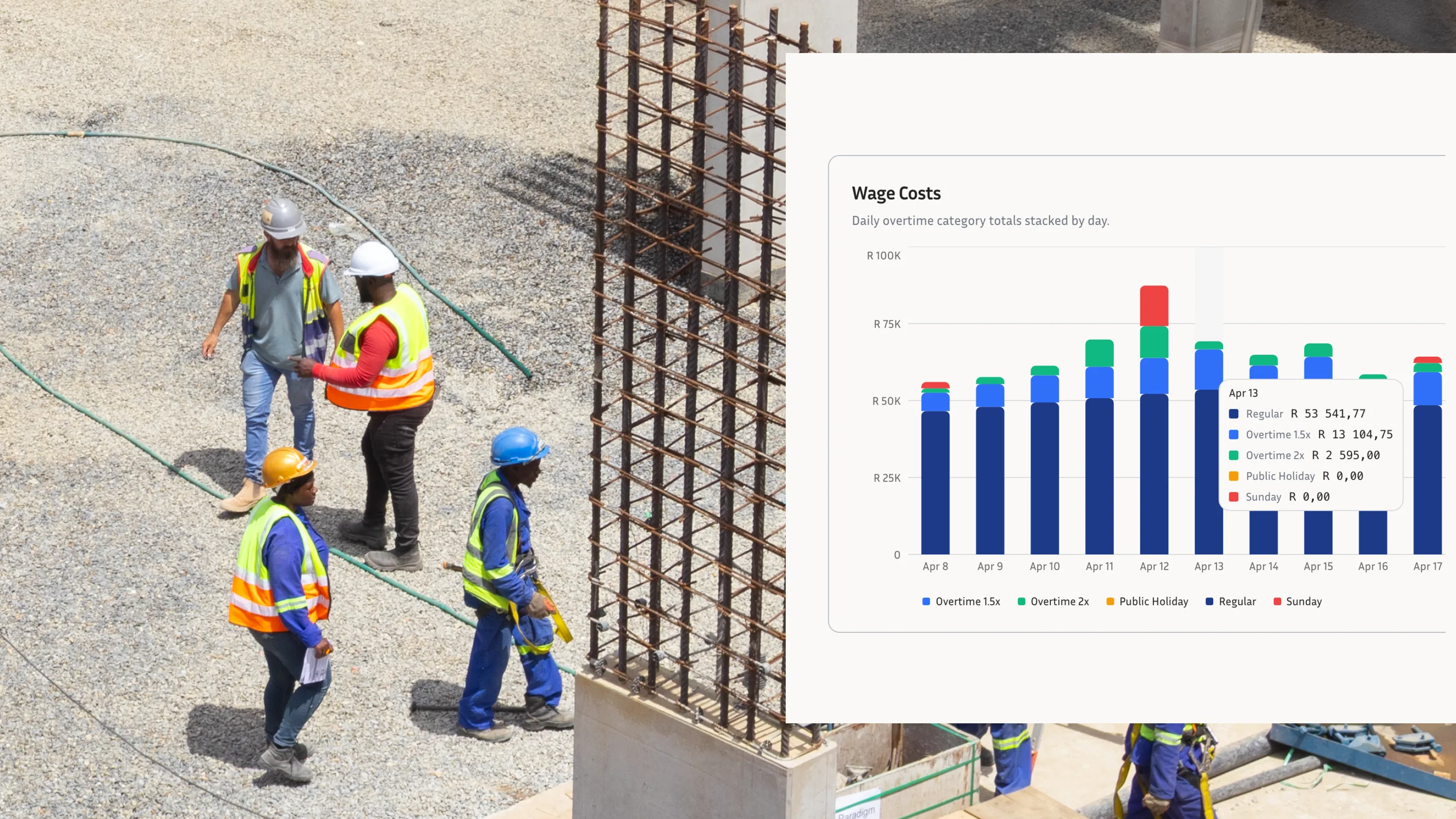
For BCEA overtime and overtime rate South Africa compliance, the payroll system needs to understand when a shift crosses calendar days and when it crosses premium-pay days such as Sundays and public holidays. A worker on an 18:00 to 06:00 shift may have ordinary hours, overtime, night-work compensation, and Sunday or public-holiday premiums interacting in one record, depending on the employment agreement and the rest of that worker's schedule. If the worker has already completed ordinary hours before starting the night shift, the combined hours determine when overtime kicks in. Getting this wrong produces a systematic underpayment risk across every night shift on site, compounding invisibly with each pay cycle.
The Sunday calculation is where the largest liability sits for round-the-clock construction businesses. Under the BCEA, work on a Sunday is paid at double the employee's ordinary rate unless Sunday is the employee's ordinary work day, in which case the rate is 1.5x. The Act also has a specific rule for shifts that fall partly on a Sunday and partly on another day: the whole shift is deemed to have been worked on Sunday unless the greater portion was worked on the other day. For workers on rotating shift schedules, which day counts as an ordinary work day must be set out clearly, and on a 24-hour site with three rotating crews, getting this wrong compounds across 20-plus workers every single week.
An overtime calculator won't catch this error automatically unless the system knows where midnight falls within each shift. Manual timesheets and paper records can't track this reliably, because the person completing the timesheet on Monday morning is working from memory about which hours fell on which calendar day. Digital clocking with automatic timestamps removes that ambiguity from the process entirely.
Concrete Pours, Tunnel Work, and Emergency Repairs
Some 24-hour construction work isn't discretionary. A structural concrete pour that begins on a Friday afternoon and runs past midnight into Saturday cannot stop midway without creating a structural defect in the slab or column. Tunnel work requires continuous ventilation monitoring and personnel on shift through the night. Emergency structural repairs after a failure or flood event carry safety obligations that cannot wait for a business day. These are the scenarios where site managers feel most justified in requiring extended hours, and where labour law South Africa compliance gets missed most consistently.
The BCEA does not create a blanket payment exemption for operationally necessary continuous work. Emergency work may affect which working-time limits apply in the moment, but it does not turn premium hours into ordinary hours by default. The overtime rate South Africa requirements still need to be checked against the worker's contract, the BCEA rules, and the day on which the hours fall, including Sunday and public holiday premiums where they apply.
Running a 22-hour concrete pour over a weekend compounds the premium calculation across two days and potentially into Sunday rates at the midnight mark. The practical point for site managers is this: the emergency or continuity justification gives you the right to require the hours; it does not alter the rate. Document the operational reason for the extended shift, clock the hours with precision, and pay the correct premium. For more on how Sunday and public holiday premiums calculate in construction scenarios, the article on BCEA Sunday pay and public holiday rates covers the full multiplier framework.
Why CCMA Disputes Over Night Shift Premiums Come Down to Clocking Records
Disputes over unpaid night work allowances, Sunday premiums, and BCEA overtime for round-the-clock operations are among the harder CCMA cases for construction employers to defend. The worker claims they worked specific hours at specific rates; the employer needs records that confirm the actual start and end time of each shift, including which calendar day each hour fell on. BCEA Section 31 requires that employers keep detailed wage records, including ordinary and overtime hours worked and any allowances paid. A claim for unpaid Sunday hours going back 12 months requires 52 weeks of accurate, verifiable shift records.
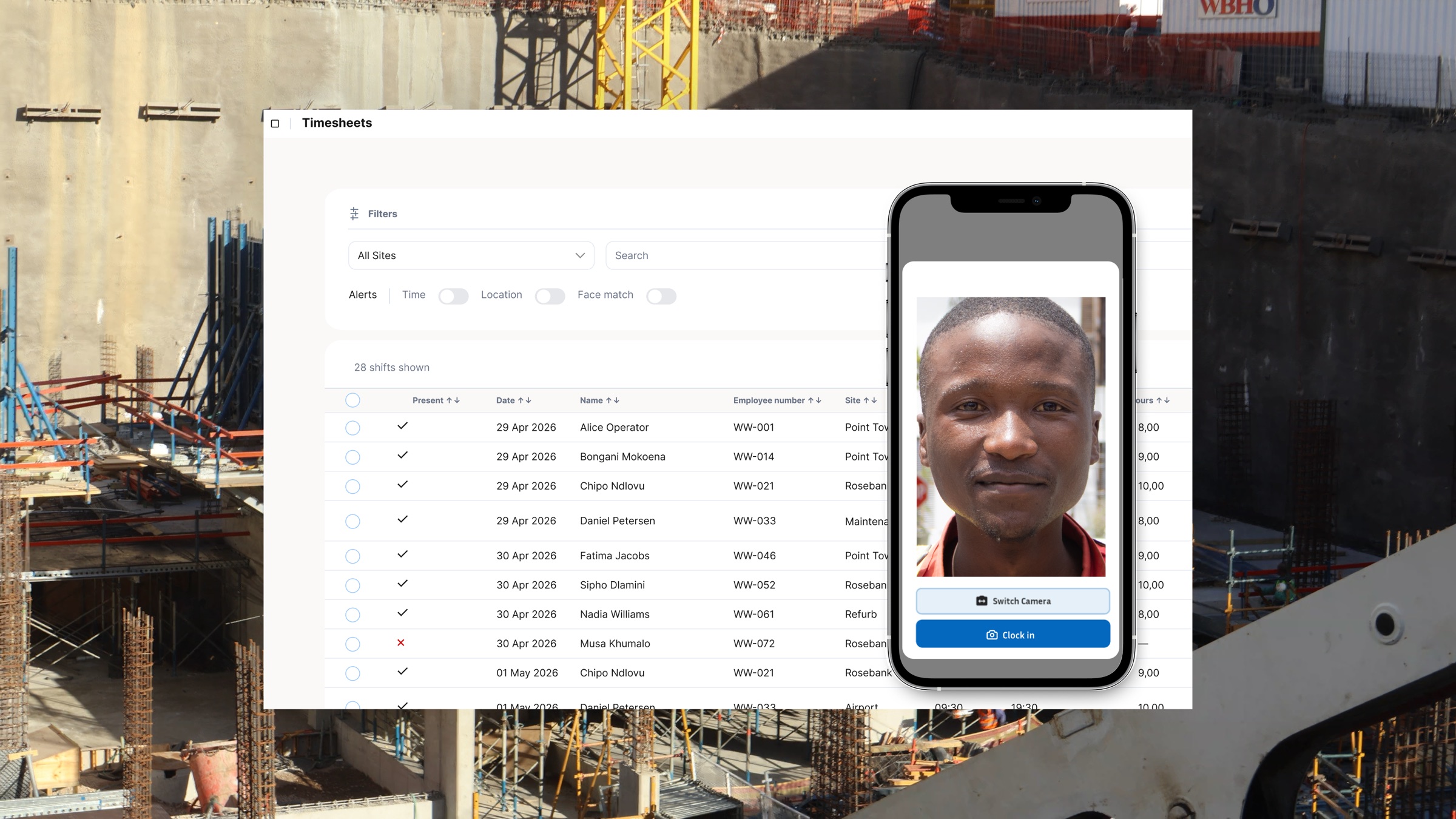
Paper timesheets and manually entered spreadsheets don't meet this evidential standard in practice. A CCMA commissioner reviewing a handwritten shift register for a six-person night crew over a three-month period will question its accuracy, particularly when entries look retrospectively completed or show consistent round-number clock-in times. Verified digital records from a clocking system for employees, with GPS-confirmed location, facial clocking authentication, and automatic timestamps, produce exactly the kind of evidence Section 31 requires: each record is stamped by the system at the moment of clock-in, not filled in by a foreman the following morning. WorkWeek's smart time recording captures each clock-in and clock-out with identity verification and location confirmation, writing records locally and syncing when connectivity returns.
For businesses with multiple rotating crews on a 24-hour site, the multi-site management dashboard shows which workers were on site during each shift window across every crew and location. When a CCMA referral names eight workers and claims unpaid Sunday premiums across ten weeks, the ability to produce verified, timestamped records for each worker in minutes changes the outcome of the conciliation.
Building the Compliance Framework for Your Round-the-Clock Site
Compliance for 24-hour construction operations doesn't require a separate document set from your standard site compliance pack. It requires that the standard documents are completed correctly for shift workers. Every employment contract must specify whether night work is a requirement, what the night work allowance is, what the employee's ordinary work day is (which determines the 1.5x versus 2x Sunday rate), and what the weekly rest arrangement is. Section 10 overtime agreements apply equally to night shift workers. Agreements concluded at the start of employment or during the first three months can lapse after 12 months, so construction teams need a renewal check rather than assuming old paperwork still covers every shift.
An expired or missing overtime agreement on a night crew creates the same dispute risk as on a day crew. The same BCEA overtime agreement renewal obligations apply, and the same CCMA exposure follows when agreements lapse. For the hours-of-work calculation across a 24-hour cycle, the method is consistent: map each shift against the actual start and end times, not the shift label; track rest periods between consecutive shifts as a compliance check, not just a scheduling task; and apply the Sunday-shift rule when a shift spans Sunday and another day. An employee clocking system that records actual start and end times, rather than relying on shift templates, makes this calculation automatic rather than manual.
For construction businesses already running payroll through Sage or SimplePay, accurate clocking data that exports payroll-ready files removes the step where shift records get re-entered manually. That re-entry step is precisely where midnight-crossing shift data gets simplified, flattened into a standard shift duration, or entered as a single-day block, and the premium calculation disappears from the payslip before anyone notices. Payroll software South Africa integration only works cleanly when the time data feeding into it carries the precise shift date and timestamp, not just a total hours figure for the week.
The HR software South Africa and workforce management software tools that serve standard operations can handle these calculations, but only if the clocking data they receive is structured correctly at the point of capture. Biometric clocking or facial clocking at the site gate that records exact timestamps for each entry and exit provides that structure. A timesheet app where workers self-report hours at the end of the week cannot. For a worked example of how BCEA overtime calculates from verified hourly data, the step-by-step breakdown covers the hourly rate derivation and the 1.5x and 2x multiplier scenarios in full.
Round-the-clock construction work is a fact of the sector, and the compliance framework built for standard shifts won't automatically extend to cover night work allowances, 12-hour rest gaps, midnight-reset overtime calculations, or Sunday premiums on rotating crews. Concrete pours don't stop because the BCEA is complicated, and tunnel inspections don't wait for a business day. Get verified clocking records in place first: every calculation in this article depends on accurate, timestamped shift data that a site manager can produce in a CCMA hearing without searching through paper registers. Book a demo with WorkWeek to see how a time and attendance system built for SA construction handles shift data across 24-hour cycles, from facial clocking at the site gate to payroll-ready exports through Sage or SimplePay.