Most employers hear minimum wage increase and think payroll adjustment. Review the rate. Update the system. Done.
In construction, it is rarely that simple. You are managing hourly workers across multiple active sites, different job categories, changing shift patterns, and wage rules that may sit under both the National Minimum Wage and industry-specific wage agreements.
That is why the National Minimum Wage increase to R30.23 per hour matters so much for construction employers in South Africa. The rate changed on 1 March 2026, but the real compliance risk is not just the rate itself. It is whether your business can prove the right hours were captured, the right rate was applied, and the right wages were paid.
What changed and when
The statutory National Minimum Wage increased from R28.79 to R30.23 per hour, effective 1 March 2026. That is a 5 percent increase under the annual review cycle of the National Minimum Wage Act.
For construction employers, the key point is that the NMW is a legal floor. If your workforce falls under a bargaining council agreement or any other industry-specific wage arrangement, those rates may still set the applicable pay by region, role, or category. You need to verify both the NMW and any wage agreement that applies to your sites.
Even where sectoral rates are higher, the NMW increase still matters. Any worker not covered by a higher applicable rate must receive at least R30.23 per hour from 1 March 2026.
Why accurate hour tracking is the real compliance issue
You cannot calculate compliant wages without accurate hours. That sounds obvious, but many construction businesses still rely on paper timesheets, bulk-signed attendance registers, or clock-in processes that are easy to manipulate or hard to verify.
A foreman rounding hours across a large crew introduces wage calculation errors at scale. A register signed at the end of the day does not capture real start and finish times. Buddy punching creates a record for work that may not have happened and hides work that did.
Compliant wages start with accurate hours. If the hours are wrong, everything downstream is wrong. With the NMW now at R30.23 per hour, the cost of overcounting, undercounting, or underpaying is higher than it was before.
The specific risks for construction employers
Construction carries a higher workforce compliance risk because labour is distributed, shift patterns are inconsistent, and documentation has to stand up under inspection.
- Multiple sites and multiple rates can create wage confusion if your records do not show exactly where each worker was and when.
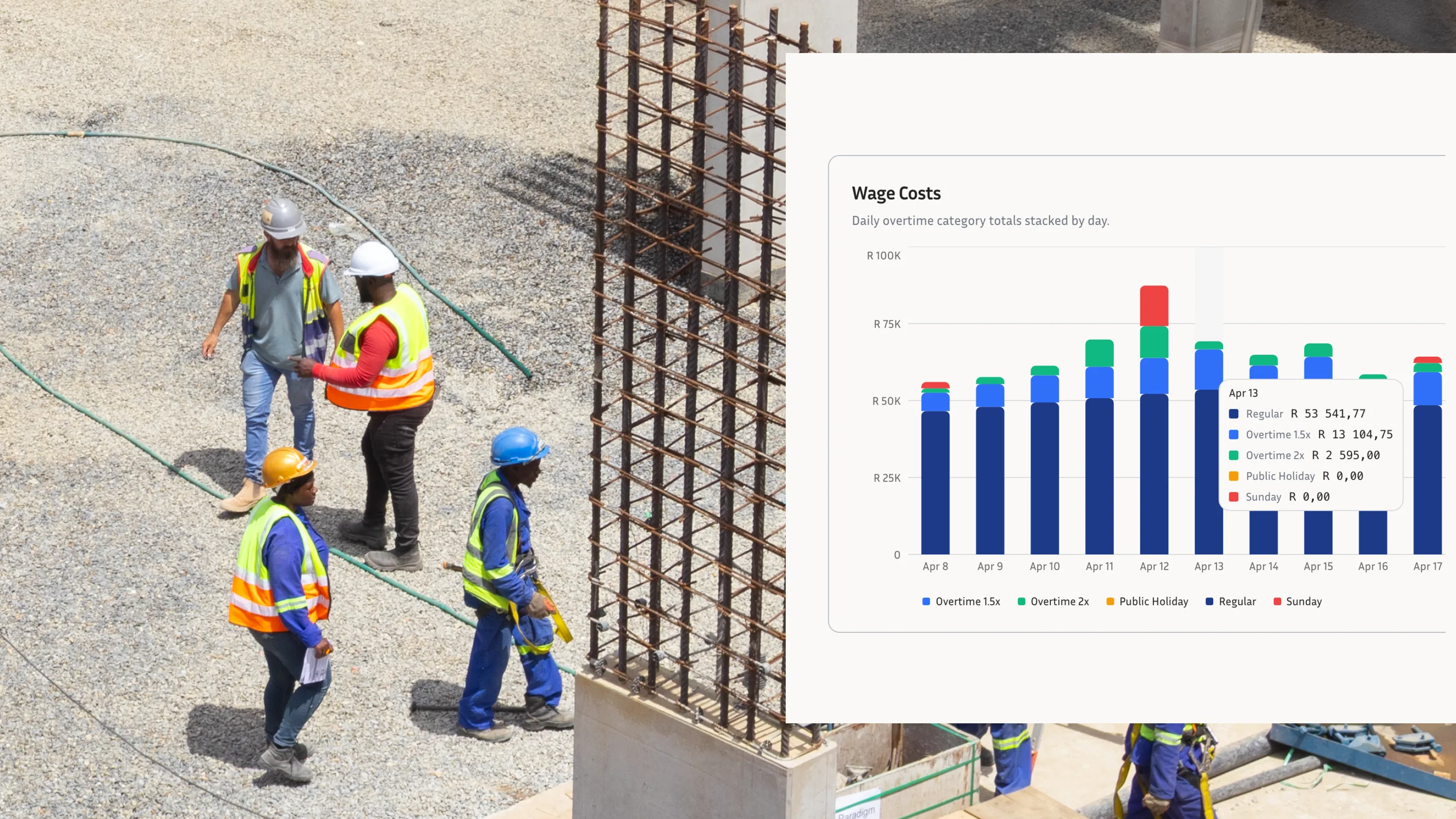
- Variable shifts and overtime need accurate start and finish times because overtime is calculated on top of the new ordinary wage rate.
- Casual workers, day labourers, and part-time staff still carry minimum wage entitlement, so poor hour tracking creates real underpayment risk.
- Department of Employment and Labour inspections put the burden of proof on the employer, so weak records are a direct compliance exposure.
March 2026 compliance checklist for employers
If you manage construction labour in South Africa, this is the practical checklist to work through now.
- Confirm whether each worker falls under the National Minimum Wage or another applicable wage agreement, and pull the correct rate tables for the relevant region and job category.
- Update payroll to reflect the new minimum wage rate of R30.23 per hour from 1 March 2026 wherever no higher applicable rate applies.
- Review your hour-tracking process and ask whether you can produce an accurate, time-stamped record of hours worked per worker, per site, per day.
- Audit overtime formulas because overtime must be paid at 1.5 times the ordinary wage, and that ordinary wage has just increased.
- Check records retention so timesheets, clock-in records, and wage calculations are preserved for at least three years and can be retrieved if challenged.
What good hour tracking looks like in construction
Paper timesheets can be amended. Verbal agreements cannot be proved. A foreman's memory is not a compliance record. The employers staying ahead of labour compliance are the ones using digital, site-level time tracking that captures the worker, the site, the time, and the attendance evidence in one flow.
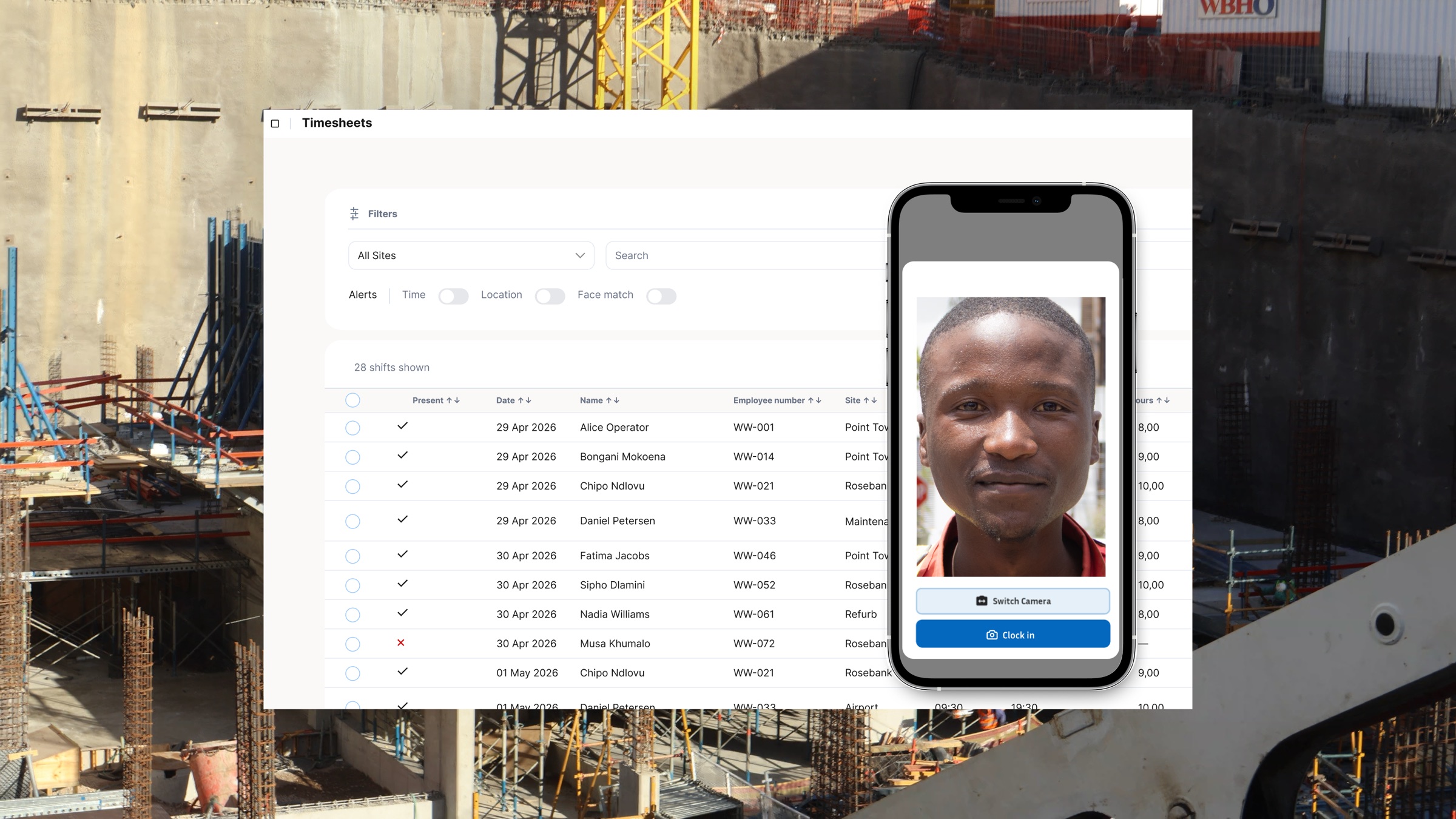
When workers clock in at the start of a shift, the system verifies location, confirms identity, and turns that record into payroll-ready data. That removes manual transcription, end-of-day estimation, and the weak points that turn a wage increase into a payroll failure.
It also makes inspections cleaner. Here is the record. Here is the rate. Here is the calculation. Here is the payment. Everything is tied together, timestamped, and retrievable.
The bigger picture for construction payroll compliance
The National Minimum Wage has increased every year since it was introduced in 2019. It will rise again in future. Each increase raises the cost of unreliable time tracking, weak payroll controls, and poorly documented attendance records.
This is not about compliance theatre. It is about protecting your business, treating workers fairly, and building a payroll system that can stand up under pressure. The 2026 increase is a prompt to tighten the system before the next change arrives.
If you want to capture accurate hours across every site and make construction wage compliance easier to prove, speak to WorkWeek. We help South African construction companies build reliable payroll-ready time-tracking records that reduce compliance risk.