The infrastructure realities of South Africa demand software built for South Africa, not software built for Silicon Valley and sold here.
For construction, civil contracting, facilities management, security, and other field-based teams, data-free time tracking is not a nice-to-have. It is the difference between complete records and broken payroll inputs.
What this article covers
- What "data-free" means in the context of workforce management
- Why mobile data costs in South Africa are a genuine workforce barrier
- Why construction, civil contracting, and field-based teams cannot rely on internet-dependent tools
- How WorkWeek was built specifically for South African operating conditions
- Why tools built offshore consistently fail South African field teams
- How WorkWeek compares to globally marketed alternatives
The problem with internationally built workforce apps in South Africa
When a workforce management app is built in the United States, Israel, or Western Europe, it is usually designed around assumptions that simply do not hold in South Africa.
- Workers have access to stable mobile data.
- Data costs are low relative to income.
- Internet connectivity is reliable and consistent across job sites.
- Smartphone data plans are a routine business expense.
None of those assumptions are true for much of South Africa's wage-earning workforce, especially in construction, civil engineering, facilities management, and field services. The result is a category of apps that look polished in a demo and then fail in the field.
Workers cannot clock in. Data runs out. The app needs to reload before it responds. Attendance records are incomplete. Payroll disputes start. Management loses visibility. This is not theoretical. It is a recurring operational problem across South African job sites.
The data affordability crisis in South Africa
South Africa remains one of the more expensive mobile-data markets in Africa relative to income, and that matters when your workforce app expects workers to come online simply to prove they arrived at work.
For workers earning close to the National Minimum Wage, mobile data is not a minor convenience cost. It is a real financial burden. Asking a construction labourer to spend personal data to operate a company app is an unreasonable design assumption.
The problem gets worse because many South African workers use prepaid SIM cards rather than contract bundles. Prepaid data is bought in small amounts, managed tightly week by week, and often exhausted before month-end.
- It expires if unused.
- It is rationed to cover WhatsApp, calls, and essential browsing.
- It is frequently purchased in small bundles to manage cash flow.
- It often runs out before the end of the month.
When time-tracking software requires active data to clock in, workers are forced into a poor choice: spend their own money to complete a company task or skip the clock-in. Many choose the second option. The attendance record is then incomplete, not because the worker was absent, but because the app was never built for the way they live.
Load shedding, rural connectivity, and the infrastructure reality
Data cost is only one part of the problem. Infrastructure reliability is the other. South Africa's energy instability and uneven network coverage create conditions where a live internet connection cannot be treated as a dependable baseline.
Load shedding directly affects network resilience. When power cuts stretch on, mobile towers fall back to batteries, and prolonged outages can push those towers offline. In the same areas already dealing with power cuts, network quality can drop sharply or disappear entirely.
Rural construction zones, mining sites, civil infrastructure projects, and remote facilities have an additional challenge: coverage can be weak, variable, or absent for long stretches of the day. For a team working far from the nearest town, requiring active internet to clock in is not a feature. It is a failure to understand the operating environment.
What "data-free" actually means
WorkWeek was built with one core design constraint: it must work in South Africa, for South African workers, in South African conditions. In practice, that means data-free time tracking is not a slogan. It is an architectural decision.
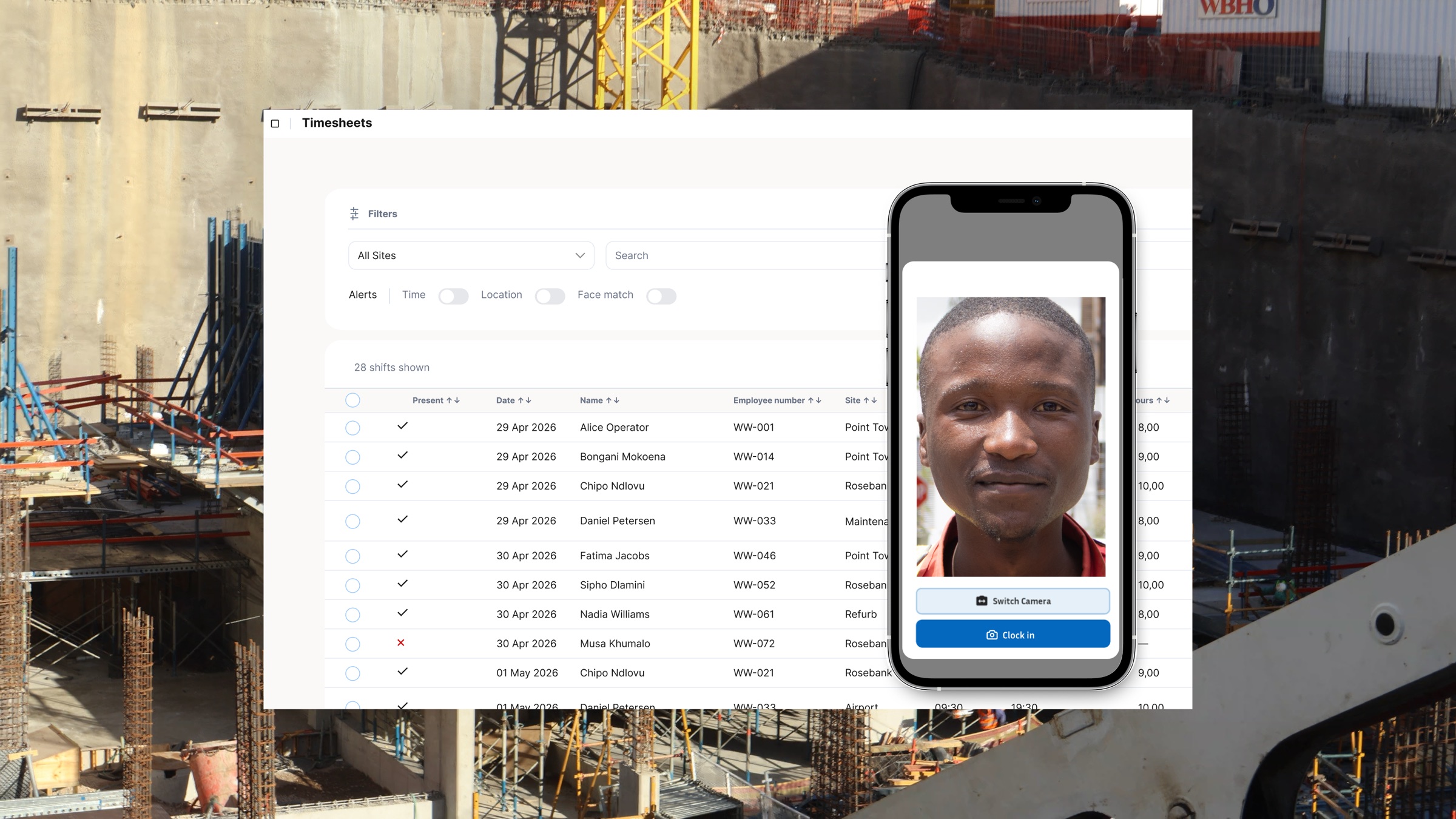
- Offline-first clock-ins let workers record attendance without an active internet connection.
- The device stores the clock event locally and syncs it when connectivity returns.
- Workers are not forced to burn personal data just to record that they are present.
- Attendance integrity does not depend on a live connection to a remote server.
- The experience remains workable on older or lower-spec smartphones used across the wage-earning workforce.
That matters for payroll accuracy. In South Africa's construction and civil contracting sector, wage disputes are a serious operating risk. If your clock-ins fail because workers are out of data or a tower goes down, you do not just have a product issue. You have a compliance issue.
Why global software keeps failing local field teams
There is a real difference between software that is available in South Africa and software that is built for South Africa. Globally marketed workforce platforms are often feature-rich and impressive in procurement, but they are designed around the operating conditions of their home markets.
That usually means reliable connectivity, cheaper data relative to wages, and a workforce less dependent on prepaid mobile usage. Once those assumptions break, the product's architecture starts working against the business using it.
South African companies then end up paying for global software while carrying the local cost of its failure. That pattern is visible well beyond workforce management, but it is especially damaging when attendance capture, payroll accuracy, and labour compliance depend on the software functioning properly on site.
What contextually appropriate technology looks like in South Africa
WorkWeek is designed as a contextually appropriate product for South Africa. The platform is architected for intermittent connectivity, not built for broadband-rich markets and patched for offline later.
- It is designed around local infrastructure constraints.
- It does not assume workers should carry employer software costs on their own phones.
- It reflects South African record-keeping and payroll realities.
- It is built for labour-intensive sectors like construction, civil contracting, facilities management, security, and field services.
WorkWeek and international alternatives through a South African lens
The practical difference between WorkWeek and internationally marketed alternatives becomes obvious on real job sites. If a product assumes a live internet connection for core attendance actions, then it is already mismatched to large parts of South African operating reality.
For a construction team on a remote civil project or a facilities crew working across load-shedding-affected sites, that mismatch is not a minor inconvenience. It is an operational failure. The app may still be good software in its home market, but that does not mean it is the right architecture for South Africa.
Key reasons South African field teams need data-free workforce management
- Your workers should not pay for your workforce system. When clocking in requires active mobile data, the business is quietly shifting an operating cost onto the workforce.
- Incomplete records create payroll and legal exposure. A missed clock-in caused by no data is still a missing attendance record with downstream compliance consequences.
- Site managers need visibility, not excuses. Workforce accountability only works when records are consistent and reliable across every site.
- South Africa's infrastructure is unpredictable by design. Load shedding, rural coverage gaps, and prepaid data behaviour are not edge cases. They are normal conditions.
- Adoption requires zero friction. If using the system costs workers money or fails when coverage dips, usage drops and records become less reliable.
WorkWeek: time tracking built for South Africa
WorkWeek is a workforce management platform purpose-built for labour-intensive industries in South Africa. It helps businesses capture attendance accurately without depending on ideal internet conditions.
- Offline-first clock-ins that sync automatically when connectivity returns
- Selfie verification to reduce buddy punching
- Geolocation-backed attendance records
- Multi-site management across active job sites
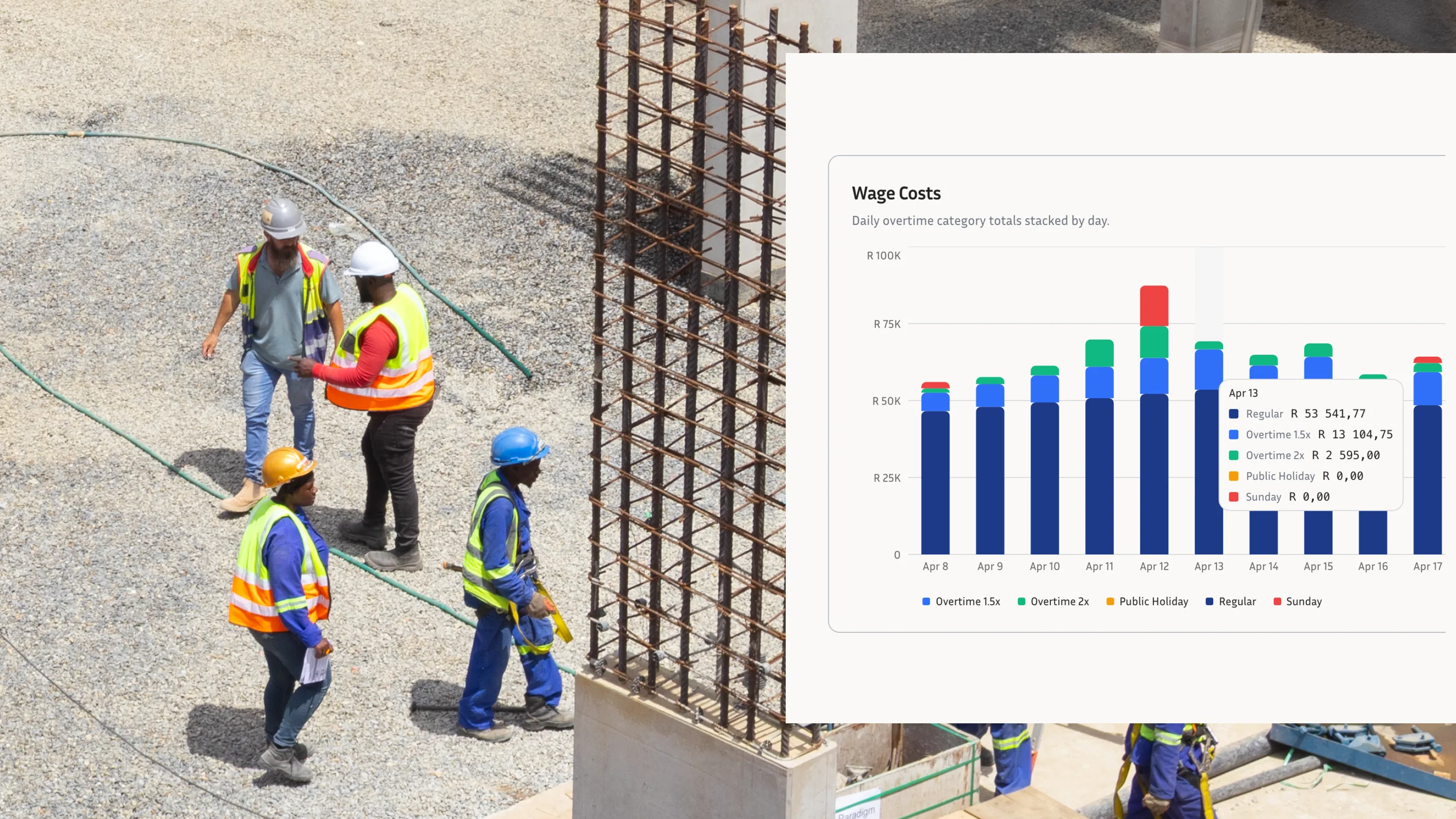
- Payroll-ready reporting that removes manual rebuild work
WorkWeek is not a global product lightly adapted for South Africa. It is a South African product, built by a South African team, for the conditions South African businesses actually operate in.
Does WorkWeek work without internet?
Yes. WorkWeek is built with offline-first functionality, so workers can clock in and out without active mobile data. Records are stored on the device and synced when connectivity is restored.
Do workers need to use their own data?
No. Core attendance functions are designed so workers do not need to consume their personal mobile data just to record their presence at work.
Is WorkWeek compliant with South African labour law?
WorkWeek is developed with South African compliance in mind, including BCEA record-keeping expectations and construction-sector payroll realities.
Can WorkWeek handle multiple job sites?
Yes. WorkWeek is built for multi-site operations across construction, civil contracting, facilities management, security, and field services.
How does WorkWeek handle load shedding?
Because core attendance actions do not depend on a live internet connection, load-shedding-related connectivity issues do not stop workers from recording attendance. Records queue locally and upload later.
If your business needs time tracking that works in South African conditions, speak to WorkWeek. We built the platform for the realities your sites are already dealing with.